
‹ Fixora — Field Service Management SaaSQuality report QR-26-00095
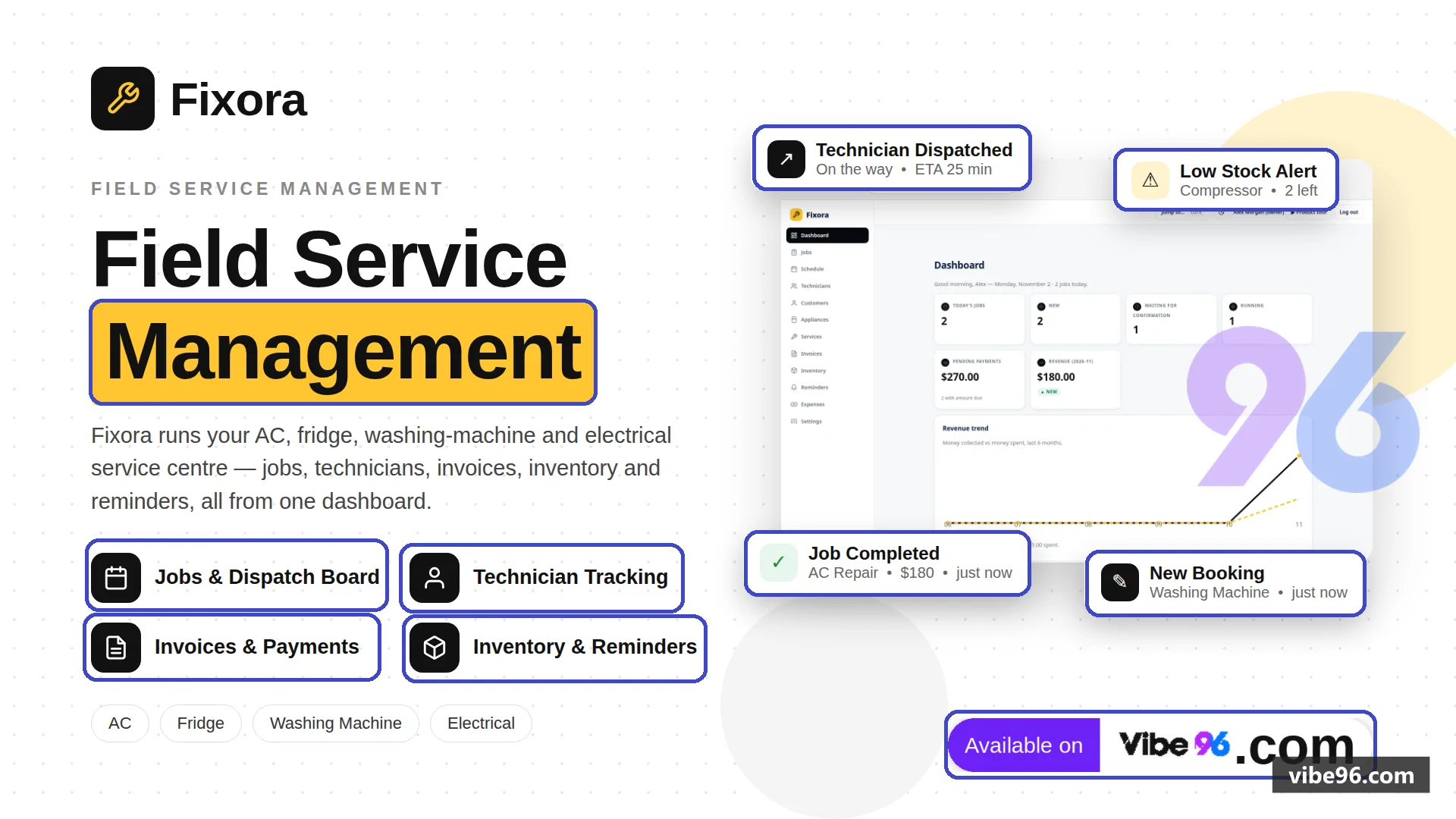
Fixora — Field Service Management SaaS
All-in-one field service management for AC, fridge, washer & electrical repair businesses.
- Product ID
- B0308-51959
- Builder
- Jehan Ahmed
- Version reviewed
- 1.0.0 · released 4 Nov 2026
- Stack
- None: zero-dependency Node.js server, vanilla JS frontend, no build step · JavaScript (Node.js 20+, no npm packages) · Supabase (PostgreSQL); no minimum version stated in the digest
- Built with
- OpenAI Codex
- Review period
- 2 Nov 2026 – 4 Nov 2026
- ✓AI code audit6 checks · 2 Nov 2026
- ✓Installed & run4 Nov 2026
- ✓Demo vs delivered4 Nov 2026
- ✓Final sign-off4 Nov 2026
At a glance
- ✓Installed and run from the delivered code — 8 of 8 checks answered yes.
- ✓Live demo compared with the delivered code — 7 of 7 checks answered yes.
- !15 of 25 promised items delivered (setup guide, example config and the rest).
- !Security scored 67/100 with no failing check.
- !5 open warnings — explained in part 1.
AI code audit
The full source archive was read by our AI auditor against each check. It reads the code — it does not run it; running it is part 2.
| Check | What we found | Score | Result |
|---|---|---|---|
| Secrets & credentials | The regex candidates are code references to environment variables, user-supplied tokens, or test fixtures, not live credentials. .env.example is blank by design and .env is excluded from the archive and Docker image. The only concern is that the same demo passwords are repeated across the test suite, and a buyer who copies them into a public demo would be using guessable credentials. | 90 | Warning |
| Dependency vulnerabilities | package.json declares an empty dependencies object, so Fixora ships no third-party npm packages and has no known-CVE exposure from dependencies. package-lock.json is present, and the Dockerfile uses the maintained node:20-alpine image. Remaining concerns are minor: the base image tag is a floating minor and Node 20 is approaching end-of-life. | 96 | Pass |
| Authorisation & access control | The visible code requires a Bearer token on authenticated routes, with documented exceptions for login and booking only. The route table in server.js is truncated, so per-route role checks and ownership checks on id lookups could not be traced. Password storage is delegated to Supabase Auth, but the in-memory store handles passwords in a way that could not be verified. | 55 | Warning |
| Database access rules | The data layer (a project file) talks to Supabase over REST, which usually avoids raw SQL concatenation, but the excerpts show none of the query construction, delete/update scoping, or schema/migration files. Tenant scoping, foreign keys, indexes and cascade rules cannot be confirmed, and plaintext password handling in the store is a concern. | 55 | Warning |
| Code structure & duplication | The top-level split (lib/ for store, rules, whatsapp and demo data; public/ for the frontend; test/ and scripts/) is readable and keeps business rules out of the UI. The main costs are that server.js is described as the whole backend and mixes routing, auth, and invoice and reminder logic, and that app.js is a single 122 KB file. Schema, migrations and setup docs are also repeated across several files, and the demo credentials are copied into four test files. | 72 | Warning |
| Build reproducibility | The project has no npm dependencies, a pinned Node 20+ engine, and a README that runs database creation, then config, then start in the right order. A clean machine can very likely run it. The Dockerfile and compose healthcheck have small gaps, and HowToSetup.md was not visible in the excerpts, so its steps could not be checked. | 80 | Warning |
Open warnings
Problems that did not stop the listing. They stay on the product page until a later version fixes them.
The regex candidates are code references to environment variables, user-supplied tokens, or test fixtures, not live credentials. .env.example is blank by design and .env is excluded from the archive and Docker image. The only concern is that the same demo passwords are repeated across the test suite, and a buyer who copies them into a public demo would be using guessable credentials.
The project has no npm dependencies, a pinned Node 20+ engine, and a README that runs database creation, then config, then start in the right order. A clean machine can very likely run it. The Dockerfile and compose healthcheck have small gaps, and HowToSetup.md was not visible in the excerpts, so its steps could not be checked.
The data layer (a project file) talks to Supabase over REST, which usually avoids raw SQL concatenation, but the excerpts show none of the query construction, delete/update scoping, or schema/migration files. Tenant scoping, foreign keys, indexes and cascade rules cannot be confirmed, and plaintext password handling in the store is a concern.
The visible code requires a Bearer token on authenticated routes, with documented exceptions for login and booking only. The route table in server.js is truncated, so per-route role checks and ownership checks on id lookups could not be traced. Password storage is delegated to Supabase Auth, but the in-memory store handles passwords in a way that could not be verified.
The top-level split (lib/ for store, rules, whatsapp and demo data; public/ for the frontend; test/ and scripts/) is readable and keeps business rules out of the UI. The main costs are that server.js is described as the whole backend and mixes routing, auth, and invoice and reminder logic, and that app.js is a single 122 KB file. Schema, migrations and setup docs are also repeated across several files, and the demo credentials are copied into four test files.
Requirement list
What the builder agreed to deliver before uploading — 15 of 25 met.
- Complete source of the web app and API Partial
- No real credentials: config files may be present but must contain placeholders or local defaults only Met
- Exactly one example config file: .env.example Partial
- Database schema that creates from empty Partial
- HowToSetup.md with at least two install targets Partial
- Pinned dependencies and lockfile Met
- Role-gated routes and per-user data isolation Partial
- Live demo with sample data Partial
- README.md, CLAUDE.md and CHANGELOG.md at root (nice)Met
- Seed data for demo (nice)Met
- Code structure without giant files (nice)Partial
- Parameterised database queries Partial
- Docs folder with deployment notes (optional)Missing
- README.md Met
- HowToSetup.md Met
- CLAUDE.md (nice)Met
- CHANGELOG.md (nice)Met
- LICENSE-NOTE.md Met
- Web a project filee Met
- Web a project file Met
- Web a project file Met
- Web a project file (nice)Met
- a project file Met
- a project file (nice)Met
- a project file (optional)Missing
Human review
Reviewers from the Vibe96 team in Dubai worked through each question below; a final reviewer signed it off.
Stage 1 — Installed and run from the delivered code
Completed 4 Nov 2026A reviewer installed the product on a clean machine, following only the guide that ships with it.
| Question | Answer | Reviewer's note |
|---|---|---|
| Packages restored without errors | Yes | |
| Solution builds clean | Yes | |
| Database created from the shipped script or migrations | Yes | |
| First sign-in works with the documented steps | Yes | |
| Setup guide is accurate and complete | Yes | |
| Every module in the feature list opens and works | Yes | |
| No real secrets in the archive | Yes | |
| Branding and company details can be changed without code | Yes |
Stage 2 — Live demo compared with the delivered code
Completed 4 Nov 2026A second reviewer checked that what the listing and demo show is what the buyer receives.
| Question | Answer | Reviewer's note |
|---|---|---|
| Demo URL is reachable | Yes | |
| Demo credentials work | Yes | |
| Demo runs the same version as the archive | Yes | |
| All five differentiators are visible in the demo | Yes | |
| Screenshots match the demo | Yes | |
| Nothing in the demo is missing from the code | Yes | |
| Datasheet claims are accurate | Yes |
Changes asked for during review
- None — approved on the first round.
- Sign-off: approved for sale on 4 Nov 2026 with 5 warnings shown publicly.
What this report covers — and what it doesn't
- It covers version 1.0.0 exactly as the buyer downloads it: the source archive, the setup guide and the live demo on the dates above.
- It is not a penetration test, a performance or load test, or a legal review of third-party package licences.
- Scores are a point in time. Libraries age; a later version is audited again and gets its own report.
- Your setup matters. Hosting, configuration and changes made after purchase are outside this review.
- How the score is made: each AI check is scored 0–100 and weighted (security counts most). A listing needs 75 or more, no failing check, and the human review passed.
- Always try the live demo before buying, and ask the builder questions from the product page.
Vibe96 FZ-LLC, Dubai, UAE. This report describes the product at the time of review and is not a warranty.