
‹ ClinicCare – Clinic Management SystemQuality report QR-26-00116
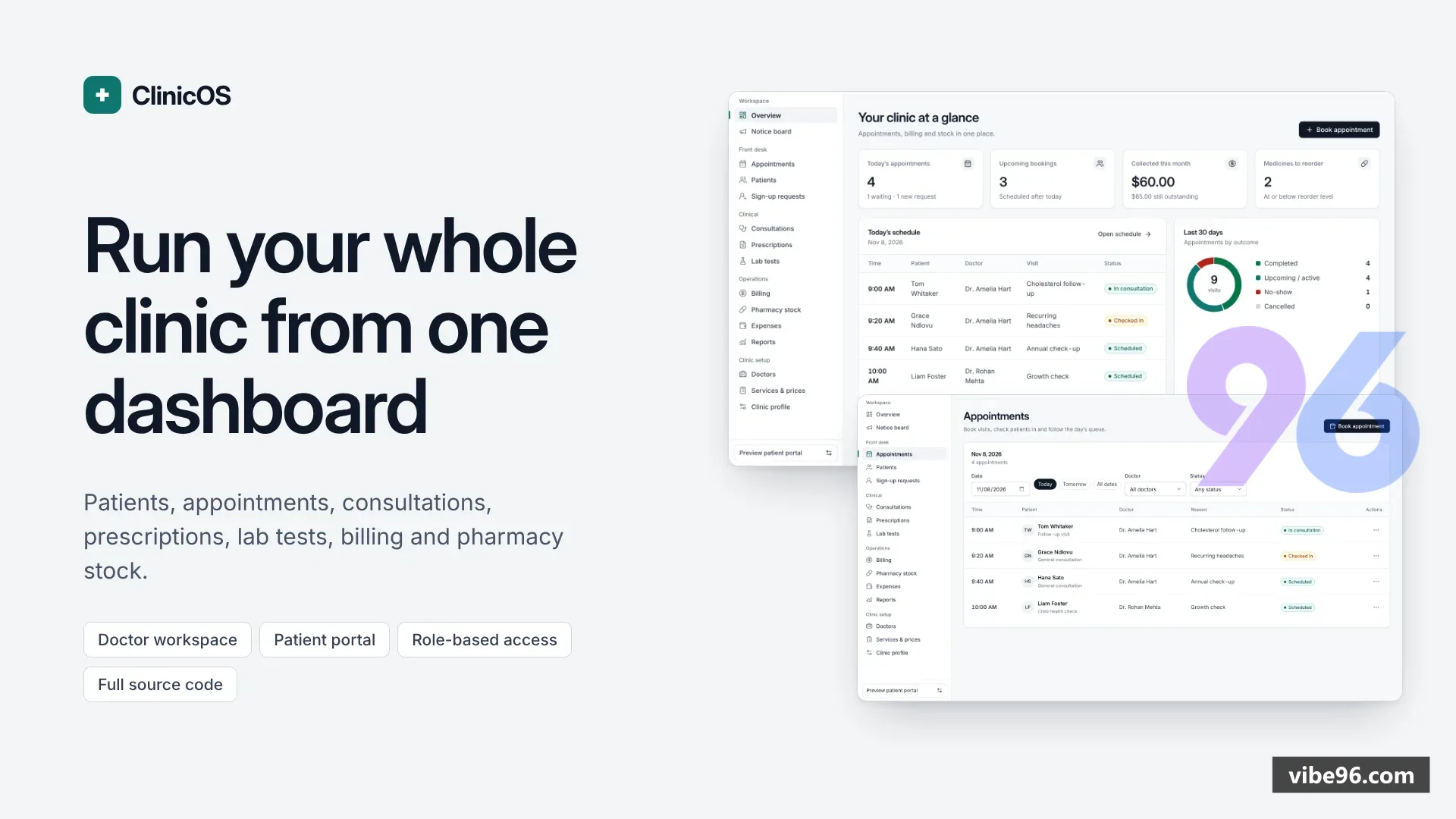
ClinicCare – Clinic Management System
Web app for single-site private clinics: patients, appointments, billing and pharmacy.
- Product ID
- B0539-82689
- Builder
- Kamrul
- Version reviewed
- 1.0.0 · released 11 Nov 2026
- Stack
- React 18.3 + Vite 6.4, with optional Supabase backend · TypeScript 5.9 (React 18.3 frontend) · PostgreSQL 16 (via Supabase; tested on PostgreSQL 16)
- Built with
- Claude Code
- Review period
- 8 Nov 2026 – 11 Nov 2026
- ✓AI code audit6 checks · 8 Nov 2026
- ✓Installed & run11 Nov 2026
- ✓Demo vs delivered11 Nov 2026
- ✓Final sign-off11 Nov 2026
At a glance
- ✓Installed and run from the delivered code — 8 of 8 checks answered yes.
- ✓Live demo compared with the delivered code — 7 of 7 checks answered yes.
- !15 of 25 promised items delivered (setup guide, example config and the rest).
- ✓Security scored 81/100 with no failing check.
- !4 open warnings — explained in part 1.
AI code audit
The full source archive was read by our AI auditor against each check. It reads the code — it does not run it; running it is part 2.
| Check | What we found | Score | Result |
|---|---|---|---|
| Secrets & credentials | The regex candidates are mostly false positives: function parameters named password in App.tsx, authCore.ts and authService.ts. The only real item is a hard-coded demo password in demoData.ts, intentionally public and shown on the sign-in screen. The project guards against it being used with a real backend: auto-login refuses to build with Supabase configured, and demo logins are disabled when Supabase is configured. The .env.example contains only placeholders, and the code uses only the Supabase publishable key. | 90 | Warning |
| Dependency vulnerabilities | a project file pins all four runtime and six dev dependencies to exact versions, and package-lock.json is present. No wildcard, 'latest' or range versions were found, and no known critical advisory could be matched from the digest. The lockfile contents were not shown, so transitive dependencies could not be checked, and several pinned versions look unusual and need confirming with npm audit. | 88 | Pass |
| Authorisation & access control | The app has no custom server routes; all access goes through Supabase Auth and PostgreSQL row-level security, which the docs say is backed by 126 allow/deny tests covering ownership and role isolation. The policies themselves (schema.sql) were not in the excerpts, so enforcement could not be verified directly. Client-side role checks are explicitly UX-only, and a public demo password path exists that must stay disabled in production. | 82 | Warning |
| Database access rules | The visible code uses the Supabase client with parameterised calls (.eq, .rpc) and no string-built SQL. The docs describe RLS, a 126-check allow/deny suite and idempotent schema scripts. However, schema.sql, cloudStorage.ts and the test SQL were not in the excerpts, so foreign keys, indexes on foreign keys, cascade rules, unscoped deletes in the diff-based sync and plain-text sensitive columns could not be verified. | 70 | Warning |
| Code structure & duplication | The project separates pages, lib, features, components and styles, keeps SECTION_ROLES in one place, and keeps pure business rules in clinic.ts. The main costs are a few places where the auth flow and configuration values are repeated or hard-coded, which are easy to consolidate. | 88 | Pass |
| Build reproducibility | The project has a lockfile, pinned dependencies, pinned Node/npm engines, a coherent multi-stage Dockerfile and compose file whose env args match .env.example. Gaps: the authors state `npm ci`/`vite build` were never verified against the registry, HowToSetup.md was not available to check ordering, and some documentation and script leftovers are inconsistent. | 82 | Warning |
Open warnings
Problems that did not stop the listing. They stay on the product page until a later version fixes them.
The regex candidates are mostly false positives: function parameters named password in App.tsx, authCore.ts and authService.ts. The only real item is a hard-coded demo password in demoData.ts, intentionally public and shown on the sign-in screen. The project guards against it being used with a real backend: auto-login refuses to build with Supabase configured, and demo logins are disabled when Supabase is configured. The .env.example contains only placeholders, and the code uses only the Supabase publishable key.
The app has no custom server routes; all access goes through Supabase Auth and PostgreSQL row-level security, which the docs say is backed by 126 allow/deny tests covering ownership and role isolation. The policies themselves (schema.sql) were not in the excerpts, so enforcement could not be verified directly. Client-side role checks are explicitly UX-only, and a public demo password path exists that must stay disabled in production.
The visible code uses the Supabase client with parameterised calls (.eq, .rpc) and no string-built SQL. The docs describe RLS, a 126-check allow/deny suite and idempotent schema scripts. However, schema.sql, cloudStorage.ts and the test SQL were not in the excerpts, so foreign keys, indexes on foreign keys, cascade rules, unscoped deletes in the diff-based sync and plain-text sensitive columns could not be verified.
The project has a lockfile, pinned dependencies, pinned Node/npm engines, a coherent multi-stage Dockerfile and compose file whose env args match .env.example. Gaps: the authors state `npm ci`/`vite build` were never verified against the registry, HowToSetup.md was not available to check ordering, and some documentation and script leftovers are inconsistent.
Requirement list
What the builder agreed to deliver before uploading — 15 of 25 met.
- Complete web application source Partial
- Database schema creates from empty Partial
- Row-level security and role checks Partial
- No real credentials Met
- Example environment file Partial
- Pinned dependencies and lockfile Partial
- HowToSetup.md with two targets Met
- Reachable demo with sample data Met
- CLAUDE.md architecture guide (nice)Partial
- Seed data (nice)Met
- Docker setup (nice)Partial
- Keep files small and layered (nice)Partial
- API and ERD documentation (optional)Missing
- README.md Met
- HowToSetup.md Met
- ClinicCare Web a project filee Met
- ClinicCare Web a project file Met
- ClinicCare Web App/.nvmrc Met
- a project file Met
- CLAUDE.md (nice)Met
- CHANGELOG.md (nice)Met
- a project file (nice)Met
- docker-compose.yml (nice)Met
- LICENSE-NOTE.md (optional)Met
- a project file (optional)Missing
Human review
Reviewers from the Vibe96 team in Dubai worked through each question below; a final reviewer signed it off.
Stage 1 — Installed and run from the delivered code
Completed 11 Nov 2026A reviewer installed the product on a clean machine, following only the guide that ships with it.
| Question | Answer | Reviewer's note |
|---|---|---|
| Packages restored without errors | Yes | |
| Solution builds clean | Yes | |
| Database created from the shipped script or migrations | Yes | |
| First sign-in works with the documented steps | Yes | |
| Setup guide is accurate and complete | Yes | |
| Every module in the feature list opens and works | Yes | |
| No real secrets in the archive | Yes | |
| Branding and company details can be changed without code | Yes |
Stage 2 — Live demo compared with the delivered code
Completed 11 Nov 2026A second reviewer checked that what the listing and demo show is what the buyer receives.
| Question | Answer | Reviewer's note |
|---|---|---|
| Demo URL is reachable | Yes | |
| Demo credentials work | Yes | |
| Demo runs the same version as the archive | Yes | |
| All five differentiators are visible in the demo | Yes | |
| Screenshots match the demo | Yes | |
| Nothing in the demo is missing from the code | Yes | |
| Datasheet claims are accurate | Yes |
Changes asked for during review
- None — approved on the first round.
- Sign-off: approved for sale on 11 Nov 2026 with 4 warnings shown publicly.
What this report covers — and what it doesn't
- It covers version 1.0.0 exactly as the buyer downloads it: the source archive, the setup guide and the live demo on the dates above.
- It is not a penetration test, a performance or load test, or a legal review of third-party package licences.
- Scores are a point in time. Libraries age; a later version is audited again and gets its own report.
- Your setup matters. Hosting, configuration and changes made after purchase are outside this review.
- How the score is made: each AI check is scored 0–100 and weighted (security counts most). A listing needs 75 or more, no failing check, and the human review passed.
- Always try the live demo before buying, and ask the builder questions from the product page.
Vibe96 FZ-LLC, Dubai, UAE. This report describes the product at the time of review and is not a warranty.