
‹ Marovelle – Real-Estate Website & CRM (Next.js, Supabase)Quality report QR-26-00124
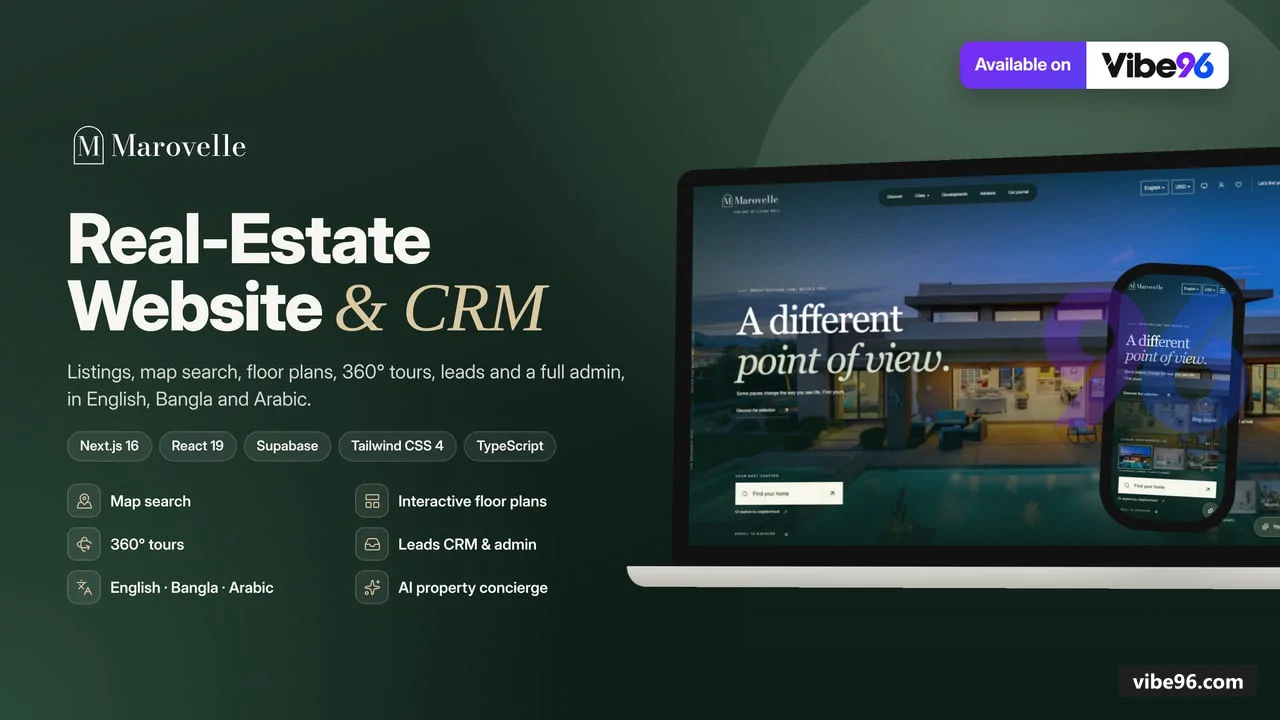
Marovelle – Real-Estate Website & CRM (Next.js, Supabase)
Real-estate website and CRM: map search, floor plans, 360° tours, payment plans, leads inbox. English, Bangla, Arabic.
- Product ID
- B1050-15891
- Builder
- Md. Sazzad Hossain
- Version reviewed
- 1.0.0 · released 12 Nov 2026
- Stack
- Next.js 16 (App Router) with React 19 · TypeScript 5.9 on Node.js 22.13+ · PostgreSQL 15+ on Supabase (hosted or self-hosted)
- Built with
- Claude Code
- Review period
- 5 Nov 2026 – 12 Nov 2026 · 3 rounds of changes
- ✓AI code audit6 checks · 5 Nov 2026
- ✓Installed & run12 Nov 2026
- ✓Demo vs delivered12 Nov 2026
- ✓Final sign-off12 Nov 2026
At a glance
- ✓Installed and run from the delivered code — 8 of 8 checks answered yes.
- ✓Live demo compared with the delivered code — 7 of 7 checks answered yes.
- !9 of 15 promised items delivered (setup guide, example config and the rest).
- ✓Security scored 80/100 with no failing check.
- !4 open warnings — explained in part 1.
AI code audit
The full source archive was read by our AI auditor against each check. It reads the code — it does not run it; running it is part 2.
| Check | What we found | Score | Result |
|---|---|---|---|
| Secrets & credentials | All regex candidates are env var reads, form fields, translation strings, or test placeholders; no live API keys, tokens or connection strings were found. The only concern is a weak, publicly documented default demo password (hardcoded fallback) that ships to buyers and could be left active on a production deployment. | 88 | Warning |
| Dependency vulnerabilities | package.json pins every dependency to an exact version (no ranges, wildcards or 'latest'), and the Dockerfile installs with --frozen-lockfile against pnpm-lock.yaml, so a lockfile exists. No dependency has a known critical vulnerability that I can identify; a few items could not be verified from the digest and are worth tidying. | 90 | Pass |
| Authorisation & access control | The project relies on Supabase row-level security, a proxy for sign-in redirects, and documented role helpers, with unit tests for role access and open-redirect protection. However, the API route handlers (reservations, revalidate, concierge, tour, Stripe webhook) and admin layout guards were not in the excerpts, so their authentication and ownership checks could not be confirmed. A few demo-related items need attention before production. | 72 | Warning |
| Database access rules | The app uses the Supabase query builder with Zod validation and row-level security on every table, and no string-built SQL appears in the visible excerpts. However, the migration files and most data-access code were not provided, so foreign-key indexes, cascade rules and scoping of deletes/updates could not be verified. Some structural concerns remain around the schema duplicating migrations and an RLS-bypassing secret key used in server paths. | 80 | Warning |
| Code structure & duplication | The project separates features, lib, components and app routes clearly, and the docs map the layout. The main structural costs are very large files (a 159 KB Bangla dictionary, a 134 KB Arabic dictionary, a 106 KB global stylesheet) and a few duplicated secret-handling and Supabase-client patterns that could be centralised. | 84 | Warning |
| Build reproducibility | The project pins exact dependency versions, declares Node >=22.13 and pnpm via packageManager, and ships a coherent multi-stage Dockerfile and compose file with a setup profile. Gaps are minor: some referenced files (proxy.ts, scripts/, supabase/migrations, pnpm-lock) could not be confirmed in the digest, and the database/setup order depends on docs not shown. | 82 | Pass |
Open warnings
Problems that did not stop the listing. They stay on the product page until a later version fixes them.
All regex candidates are env var reads, form fields, translation strings, or test placeholders; no live API keys, tokens or connection strings were found. The only concern is a weak, publicly documented default demo password (hardcoded fallback) that ships to buyers and could be left active on a production deployment.
The app uses the Supabase query builder with Zod validation and row-level security on every table, and no string-built SQL appears in the visible excerpts. However, the migration files and most data-access code were not provided, so foreign-key indexes, cascade rules and scoping of deletes/updates could not be verified. Some structural concerns remain around the schema duplicating migrations and an RLS-bypassing secret key used in server paths.
The project separates features, lib, components and app routes clearly, and the docs map the layout. The main structural costs are very large files (a 159 KB Bangla dictionary, a 134 KB Arabic dictionary, a 106 KB global stylesheet) and a few duplicated secret-handling and Supabase-client patterns that could be centralised.
The project relies on Supabase row-level security, a proxy for sign-in redirects, and documented role helpers, with unit tests for role access and open-redirect protection. However, the API route handlers (reservations, revalidate, concierge, tour, Stripe webhook) and admin layout guards were not in the excerpts, so their authentication and ownership checks could not be confirmed. A few demo-related items need attention before production.
Requirement list
What the builder agreed to deliver before uploading — 9 of 15 met.
- Complete source for every component Met
- No real credentials in the archive Met
- Builds from a clean machine Partial
- Database script or migrations Partial
- Authentication and roles on every mutating endpoint Partial
- Pinned dependencies without critical CVEs (nice)Partial
- Documentation set (nice)Met
- Working live demo Partial
- README.md Met
- HowToSetup.md Met
- CLAUDE.md (or AGENTS.md) (nice)Met
- CHANGELOG.md (nice)Met
- .env.example Met
- a project file Met
- a project file (nice)Missing
Human review
Reviewers from the Vibe96 team in Dubai worked through each question below; a final reviewer signed it off.
Stage 1 — Installed and run from the delivered code
Completed 12 Nov 2026A reviewer installed the product on a clean machine, following only the guide that ships with it.
| Question | Answer | Reviewer's note |
|---|---|---|
| Packages restored without errors | Yes | |
| Solution builds clean | Yes | |
| Database created from the shipped script or migrations | Yes | |
| First sign-in works with the documented steps | Yes | |
| Setup guide is accurate and complete | Yes | |
| Every module in the feature list opens and works | Yes | |
| No real secrets in the archive | Yes | |
| Branding and company details can be changed without code | Yes |
Stage 2 — Live demo compared with the delivered code
Completed 12 Nov 2026A second reviewer checked that what the listing and demo show is what the buyer receives.
| Question | Answer | Reviewer's note |
|---|---|---|
| Demo URL is reachable | Yes | |
| Demo credentials work | Yes | |
| Demo runs the same version as the archive | Yes | |
| All five differentiators are visible in the demo | Yes | |
| Screenshots match the demo | Yes | |
| Nothing in the demo is missing from the code | Yes | |
| Datasheet claims are accurate | Yes |
Changes asked for during review
- Round 1: changes requested on 10 Nov 2026; the builder fixed them and uploaded again.
- Sign-off: approved for sale on 12 Nov 2026 with 4 warnings shown publicly.
What this report covers — and what it doesn't
- It covers version 1.0.0 exactly as the buyer downloads it: the source archive, the setup guide and the live demo on the dates above.
- It is not a penetration test, a performance or load test, or a legal review of third-party package licences.
- Scores are a point in time. Libraries age; a later version is audited again and gets its own report.
- Your setup matters. Hosting, configuration and changes made after purchase are outside this review.
- How the score is made: each AI check is scored 0–100 and weighted (security counts most). A listing needs 75 or more, no failing check, and the human review passed.
- Always try the live demo before buying, and ask the builder questions from the product page.
Vibe96 FZ-LLC, Dubai, UAE. This report describes the product at the time of review and is not a warranty.