‹ ClinicFlow — Multi-Tenant Clinic Management & Appointment SystemQuality report QR-26-00140
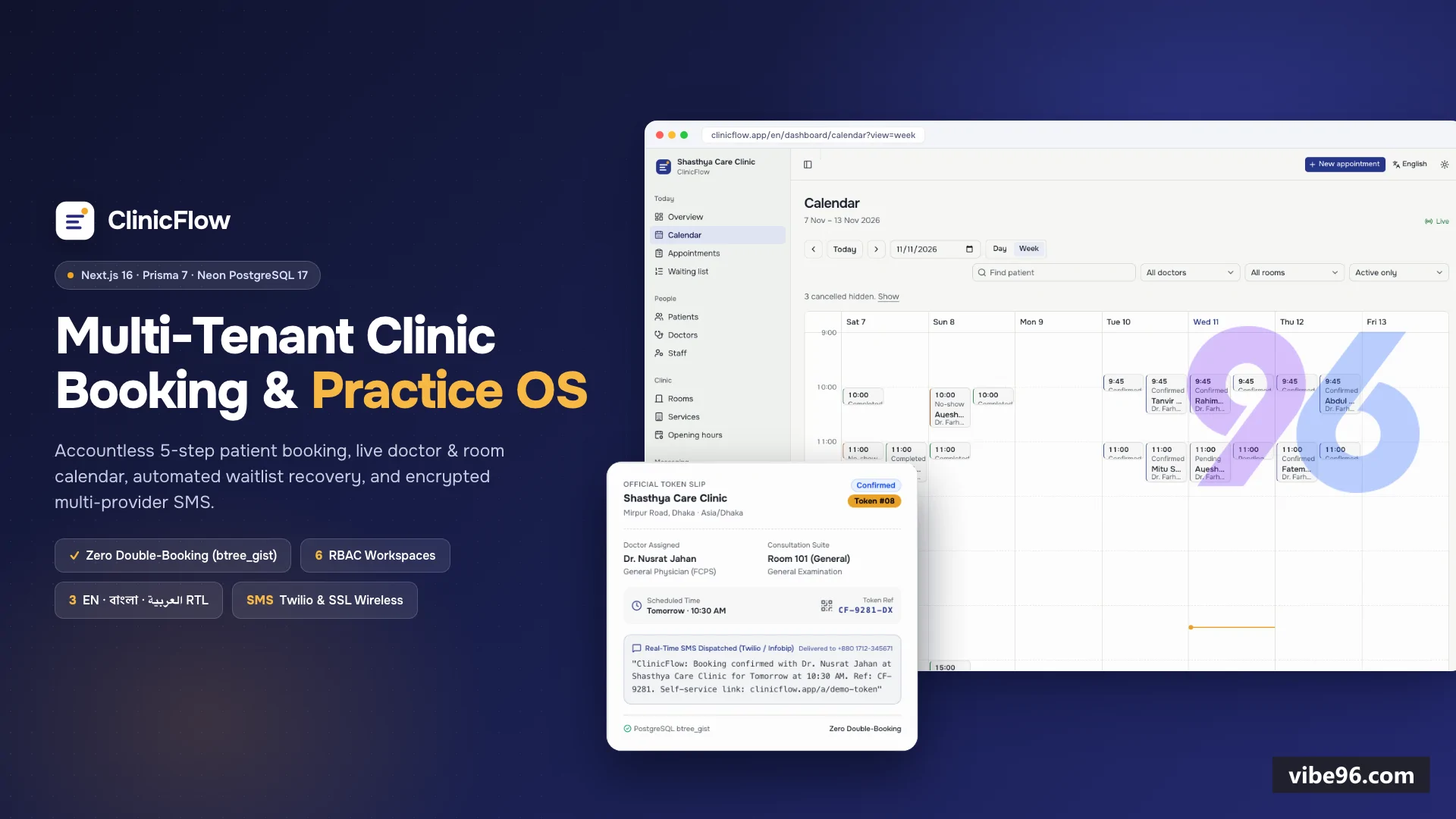
ClinicFlow — Multi-Tenant Clinic Management & Appointment System
Multi-tenant clinic booking management system clinics and hospitals, with accountless patient booking and SMS reminders.
- Product ID
- B0097-37124
- Builder
- MD FAHIM
- Version reviewed
- 1.0.0 · released 16 Nov 2026
- Stack
- Next.js 16 (App Router) with React 19 · TypeScript 5.9 on Node.js 22+ · PostgreSQL 17 (Neon) with Prisma 7; btree_gist and pg_trgm extensions
- Built with
- Claude Code, Google Antigravity
- Review period
- 11 Nov 2026 – 16 Nov 2026
- ✓AI code audit6 checks · 10 Nov 2026
- ✓Installed & run16 Nov 2026
- ✓Demo vs delivered16 Nov 2026
- ✓Final sign-off16 Nov 2026
At a glance
- ✓Installed and run from the delivered code — 8 of 8 checks answered yes.
- ✓Live demo compared with the delivered code — 7 of 7 checks answered yes.
- !20 of 24 promised items delivered (setup guide, example config and the rest).
- !Security scored 69/100 with no failing check.
- !6 open warnings — explained in part 1.
AI code audit
The full source archive was read by our AI auditor against each check. It reads the code — it does not run it; running it is part 2.
| Check | What we found | Score | Result |
|---|---|---|---|
| Secrets & credentials | No live API keys, private keys, or real database URLs were found. The scan hits are placeholders, docker-compose local dev values, and a publicly documented demo password hardcoded in the seed and landing page. These are weak defaults that could reach production if the buyer does not override them. | 85 | Warning |
| Dependency vulnerabilities | The only manifest in the digest is Next.js Web a project file. Most production dependencies use caret ranges, and the file tree shows no lockfile (lockfiles may be omitted from the digest, so this is unconfirmed). Versions can't be matched against advisories with confidence, and some oddities (a `cn` package, `shadcn` as a runtime dependency) need cleanup. | 62 | Warning |
| Authorisation & access control | The digest only exposes docs, config and generated Prisma code, not the server actions (src/actions), the /cron/run route, /media/[id] or the dashboard/platform pages, so guards and ownership checks could not be traced. Documentation claims guarded, tenant-scoped actions, Argon2 hashing and HMAC-signed patient tokens, and a tenant-isolation test exists, which is encouraging but unverified. Some surfaces are inherently high-risk and need confirmation before production use. | 60 | Warning |
| Database access rules | The digest omits all server code, Prisma query sites and the schema contents, so injection and unscoped-delete checks could not be verified directly. The project uses Prisma 7 with migrations, a seed and an SQL schema, and documents tenant-isolation tests and AES-GCM credential encryption, which is a good sign. Scoring is held down because the key files were unseen, the schema is duplicated in three places, and the seed path ships a known default password. | 62 | Warning |
| Code structure & duplication | The App Router layout separates actions, server services, and UI components sensibly, which is a good base. However, the submission duplicates the whole project (root ClinicFlow-Submission vs. 'Next.js Web App'), carries roughly 50+ Claude skill reference files and internal tooling residue, and repeats the demo password in several places, which makes it harder for a buyer to know which copy is authoritative. | 78 | Warning |
| Build reproducibility | The Next.js app has a package.json, a Prisma migration and an .env.example, and the live demo shows it builds and runs on Vercel. However, the archive duplicates docs/DB/README at two levels, commits generated Prisma output and tool folders, and the digest cannot confirm that setup steps, versions and prerequisites are correct or that a lockfile exists. A clean-machine build is plausible but not proven. | 62 | Warning |
Open warnings
Problems that did not stop the listing. They stay on the product page until a later version fixes them.
No live API keys, private keys, or real database URLs were found. The scan hits are placeholders, docker-compose local dev values, and a publicly documented demo password hardcoded in the seed and landing page. These are weak defaults that could reach production if the buyer does not override them.
The App Router layout separates actions, server services, and UI components sensibly, which is a good base. However, the submission duplicates the whole project (root ClinicFlow-Submission vs. 'Next.js Web App'), carries roughly 50+ Claude skill reference files and internal tooling residue, and repeats the demo password in several places, which makes it harder for a buyer to know which copy is authoritative.
The digest omits all server code, Prisma query sites and the schema contents, so injection and unscoped-delete checks could not be verified directly. The project uses Prisma 7 with migrations, a seed and an SQL schema, and documents tenant-isolation tests and AES-GCM credential encryption, which is a good sign. Scoring is held down because the key files were unseen, the schema is duplicated in three places, and the seed path ships a known default password.
The Next.js app has a package.json, a Prisma migration and an .env.example, and the live demo shows it builds and runs on Vercel. However, the archive duplicates docs/DB/README at two levels, commits generated Prisma output and tool folders, and the digest cannot confirm that setup steps, versions and prerequisites are correct or that a lockfile exists. A clean-machine build is plausible but not proven.
The only manifest in the digest is Next.js Web a project file. Most production dependencies use caret ranges, and the file tree shows no lockfile (lockfiles may be omitted from the digest, so this is unconfirmed). Versions can't be matched against advisories with confidence, and some oddities (a `cn` package, `shadcn` as a runtime dependency) need cleanup.
The digest only exposes docs, config and generated Prisma code, not the server actions (src/actions), the /cron/run route, /media/[id] or the dashboard/platform pages, so guards and ownership checks could not be traced. Documentation claims guarded, tenant-scoped actions, Argon2 hashing and HMAC-signed patient tokens, and a tenant-isolation test exists, which is encouraging but unverified. Some surfaces are inherently high-risk and need confirmation before production use.
Requirement list
What the builder agreed to deliver before uploading — 20 of 24 met.
- Complete source of the web app Met
- No real credentials: config files may be present but must contain placeholders or local defaults only Partial
- Lockfile and pinned dependencies Partial
- Schema creates from empty Met
- Tenant isolation and role-gated access Partial
- HowToSetup.md with at least two targets Met
- Working demo with sample data Met
- Developer-friendly structure (nice)Partial
- CLAUDE.md with architecture and test commands (nice)Met
- Seed data and docker-compose (nice)Met
- README and licence note (nice)Met
- API and deployment docs (optional)Met
- README.md Met
- HowToSetup.md Met
- Next.js Web a project filee Met
- Next.js Web a project file Met
- a project file Met
- Next.js Web a project file Met
- CLAUDE.md (nice)Met
- CHANGELOG.md (nice)Met
- a project file (nice)Met
- docker-compose.yml (nice)Met
- LICENSE-NOTE.md (nice)Met
- a project file (optional)Met
Human review
Reviewers from the Vibe96 team in Dubai worked through each question below; a final reviewer signed it off.
Stage 1 — Installed and run from the delivered code
Completed 16 Nov 2026A reviewer installed the product on a clean machine, following only the guide that ships with it.
| Question | Answer | Reviewer's note |
|---|---|---|
| Packages restored without errors | Yes | |
| Solution builds clean | Yes | |
| Database created from the shipped script or migrations | Yes | |
| First sign-in works with the documented steps | Yes | |
| Setup guide is accurate and complete | Yes | |
| Every module in the feature list opens and works | Yes | |
| No real secrets in the archive | Yes | |
| Branding and company details can be changed without code | Yes |
Stage 2 — Live demo compared with the delivered code
Completed 16 Nov 2026A second reviewer checked that what the listing and demo show is what the buyer receives.
| Question | Answer | Reviewer's note |
|---|---|---|
| Demo URL is reachable | Yes | |
| Demo credentials work | Yes | |
| Demo runs the same version as the archive | Yes | |
| All five differentiators are visible in the demo | Yes | |
| Screenshots match the demo | Yes | |
| Nothing in the demo is missing from the code | Yes | |
| Datasheet claims are accurate | Yes |
Changes asked for during review
- None — approved on the first round.
- Sign-off: approved for sale on 16 Nov 2026 with 6 warnings shown publicly.
What this report covers — and what it doesn't
- It covers version 1.0.0 exactly as the buyer downloads it: the source archive, the setup guide and the live demo on the dates above.
- It is not a penetration test, a performance or load test, or a legal review of third-party package licences.
- Scores are a point in time. Libraries age; a later version is audited again and gets its own report.
- Your setup matters. Hosting, configuration and changes made after purchase are outside this review.
- How the score is made: each AI check is scored 0–100 and weighted (security counts most). A listing needs 75 or more, no failing check, and the human review passed.
- Always try the live demo before buying, and ask the builder questions from the product page.
Vibe96 FZ-LLC, Dubai, UAE. This report describes the product at the time of review and is not a warranty.