
 Built by
About this software
About ClusterSense AI – Intelligent Cloud Infrastructure Management
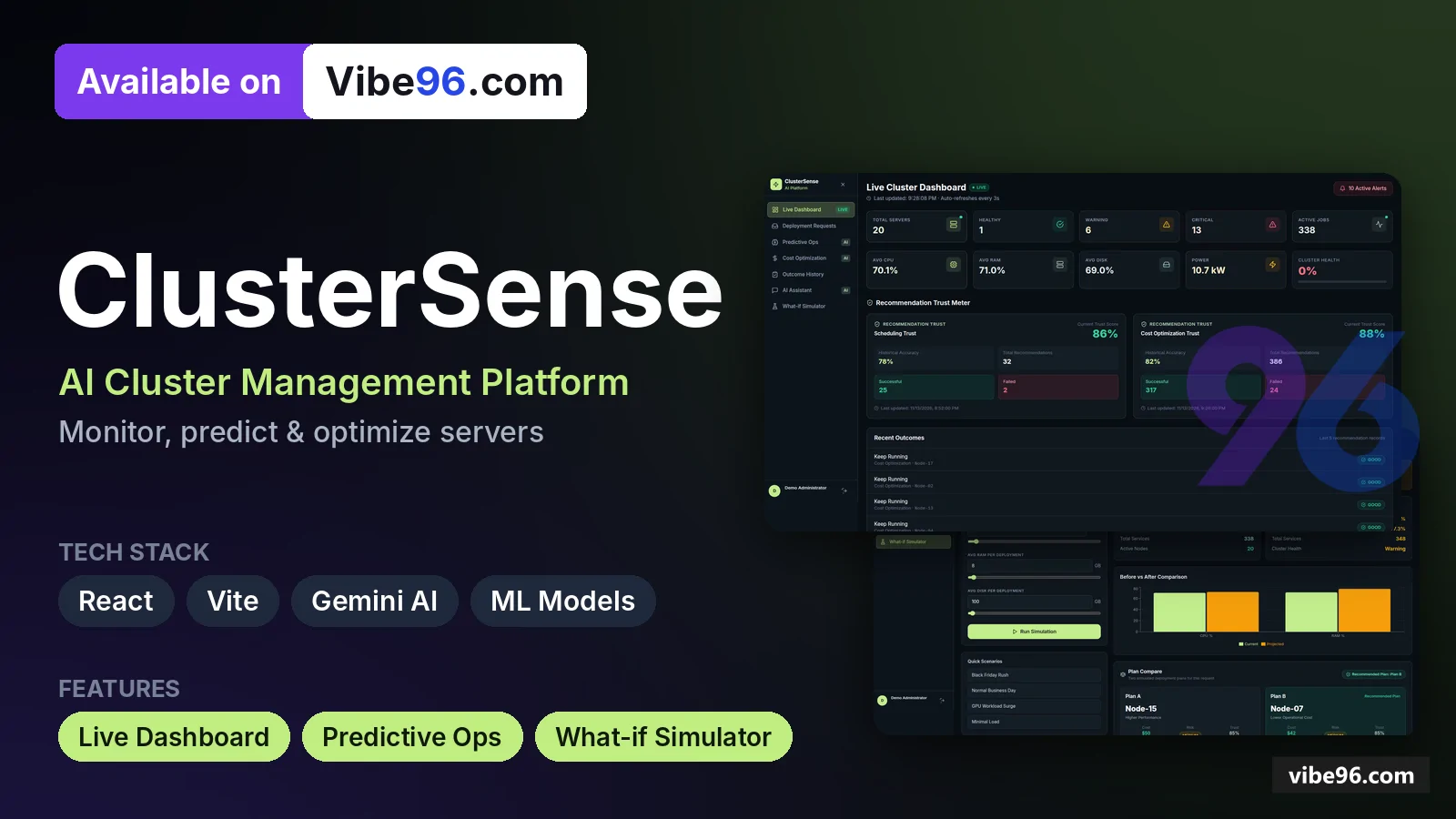
ClusterSense AI is a React, FastAPI and PostgreSQL workspace for a single hosting-provider administrator. It combines an infrastructure dashboard with scikit-learn models that are retrained from three included CSV datasets (scheduling, failure prediction, cost optimization). It also has an order portal, deployment requests, a what-if capacity simulator, outcome history, a trust meter and plan comparisons. The AI Copilot calls Gemini when an API key is set and otherwise uses a built-in fallback. Deployments and metrics are demo data: the README states it does not provision real servers, and it is not a multi-tenant customer portal. Setup is by Docker Compose or native install, with an Nginx proxy config and Vercel/Render deployment notes.
Why ClusterSense AI – Intelligent Cloud Infrastructure Management
What makes it better
than the alternatives
- 01
AI-Powered Smart Scheduling
Three retrainable ML models support intelligent server selection, failure prediction, and infrastructure cost optimization using bundled training datasets.
- 02
Predictive Failure Detection
Analyze CPU, RAM, temperature, and server health to identify operational risks and provide actionable maintenance recommendations.
- 03
What-if Infrastructure Simulator
Simulate future deployments, forecast resource utilization, compare deployment plans, and identify suitable servers before allocating workloads.
- 04
Intelligent AI Copilot
Get natural-language infrastructure insights using Google Gemini, with a built-in fallback engine when an API key is unavailable. Admin-Secured and Deployment-Ready — Admin-protected infrastructure APIs with Docker-based deployment configurations, database health checks, and environment setup scripts.
- 05
Honest documentation
README states that no live demo or screenshots exist, that transitive Python packages are not locked, and that no CVE audit has been run.
Dashboard & Alerts
- Infrastructure overview with node utilization
- Alerts API with acknowledge action
- Node listing endpoints
Smart Scheduling
- ML-assisted node selection for deployments
- Simulated deployments via the deployments API
Predictive Operations
- Failure risk estimates from a trained model
- Predictions API and dedicated page
Cost Optimization
- Cost recommendations from a model trained on cost_optimization.csv
- Plan comparison service with demo fixtures
What-If Simulator
- Capacity simulation page backed by a simulation API
AI Copilot
- Optional Gemini integration
- Built-in fallback when no API key is set
Order Portal & Deployment Requests
- Administrator order portal
- Create and manage deployment requests
Outcome History & Trust Meter
- Outcome records table (file-backed JSON demo data)
- Trust meter card and service
Authentication & Security
- JWT login with bcrypt password hashing
- Admin role check on every infrastructure route
- First-run admin seeded from environment variables
- Configurable CORS origins
Deployment & Tooling
- Docker Compose with Postgres 15
- backend and Nginx web
- Schema export and release-packaging scripts
- PostgreSQL schema.sql and optional seed.sql
| Language | Version | Framework | Used for | Share of code |
|---|---|---|---|---|
| Python | — | — | Web, API | 45.8% |
| JavaScript (React) | — | — | Front-end | 44.1% |
| SQL | — | — | Database | 3.9% |
| JavaScript | — | — | Front-end | 2.7% |
| CSS | — | — | Styling | 1.8% |
| Shell | — | — | Scripts | 1.3% |
| HTML | — | — | Front-end | 0.3% |
- Primary language
- Python 3.11 (backend) + JavaScript (React 18 frontend)
- Framework
- FastAPI 0.111 + React 18 (Vite 5, Tailwind 3)
- Database
- PostgreSQL 15 (SQLAlchemy 2.0 ORM)
- Authentication
- JWT bearer tokens (python-jose), bcrypt password hashing, single administrator role enforced by require_admin
- Licence
- Single-site
- Screens
- 12
- Supported languages
- English only; no translation library in the digest. RTL not supported
- Browser support
- Modern evergreen browsers (React 18 built with Vite; no legacy target configured)
| Minimum | Recommended | |
|---|---|---|
| CPU | 2 vCPU | 4 vCPU |
| RAM | 4 GB | 8 GB |
| OS | Linux with Python 3.11, Node.js 22, PostgreSQL 15 and nginx stable (Docker images) | Linux with Python 3.11, Node.js 22, PostgreSQL 15 and nginx stable (Docker images) |
| Est. monthly hosting | $20 | $20 |
```sh
cp .env.example .env
# Edit .env: set POSTGRES_PASSWORD, SECRET_KEY, ADMIN_EMAIL, ADMIN_PASSWORD
docker compose up -d --build
docker compose ps
```

The web UI is bound to http://127.0.0.1:8080. Put a TLS reverse proxy in front for public use (deploy/nginx.conf is provided).
```sh
cp backend/.env.example backend/.env
# Edit backend/.env with unique values for DATABASE_URL, SECRET_KEY and ADMIN_PASSWORD
python3 -m venv backend/venv
backend/venv/bin/pip install -r backend/requirements.txt
backend/venv/bin/python train_models.py
backend/venv/bin/python -m unittest discover -s tests -v
```

Follow HowToSetup.md for the full Ubuntu/VPS steps, including database initialisation and first administrator login.
Quality report
Manually reviewedHow to read the quality report
What this is. Every project on Vibe96 goes through an automated audit of its source code before a reviewer in Dubai checks it by hand. The score is out of 100; 75 is the minimum to be listed, and any single failing check blocks a listing regardless of the score.
- Security
- No real credentials in the code, every data-changing route protected, admin areas role-gated, no SQL built from user input.
- Code structure
- A developer can navigate and extend it: clear module boundaries, no giant files, little copy-paste.
- Docs & completeness
- The setup guide, example config, schema and required files the builder committed to are actually in the archive.
- Dependency health
- Packages pinned, no known critical vulnerabilities, no abandoned libraries in production paths.
- Build & deploy
- A clean machine can restore, build and start it by following the shipped instructions.
Warnings are problems that didn't block the listing; they stay visible here until a later version clears them. The audit reads the code — it does not run it — so always try the live demo before you buy. Lines of code are counted from the same audited archive.
Reviewer notes (4 minor)
Routers are split by domain, but config is duplicated and auth dependencies sit inside a router module; admin-only design with tests, but most route files unseen; some public/health endpoints and login hardening gaps; auth queries are safe orm calls, but most db code and the schema were not provided, so it is only partly verifiable; python deps pinned but several have known cves and no lockfile; npm lockfile present but ranges are caret-based; mostly reproducible docker/native build; setup doc unseen, python deps unlocked, a few coherence gaps. None of these stop the software from working; the developer has been told and improvements come in a future update.
Versions & updates
No updates yet. New versions appear here with a changelog.
Buyers receive updates free for 1 year.
What you get
- </>Full source codeThe complete audited source, delivered as a download from your account. No obfuscation.
- ▤DocumentationSetup guide, architecture notes, CLAUDE.md and AGENTS.md.
- ↻One year of updatesEvery new version the builder publishes, free for 12 months.
- ♧30 days of supportInstallation and defect support through Vibe96 tickets.