
‹ ClusterSense AI – Intelligent Cloud Infrastructure ManagementQuality report QR-26-00153
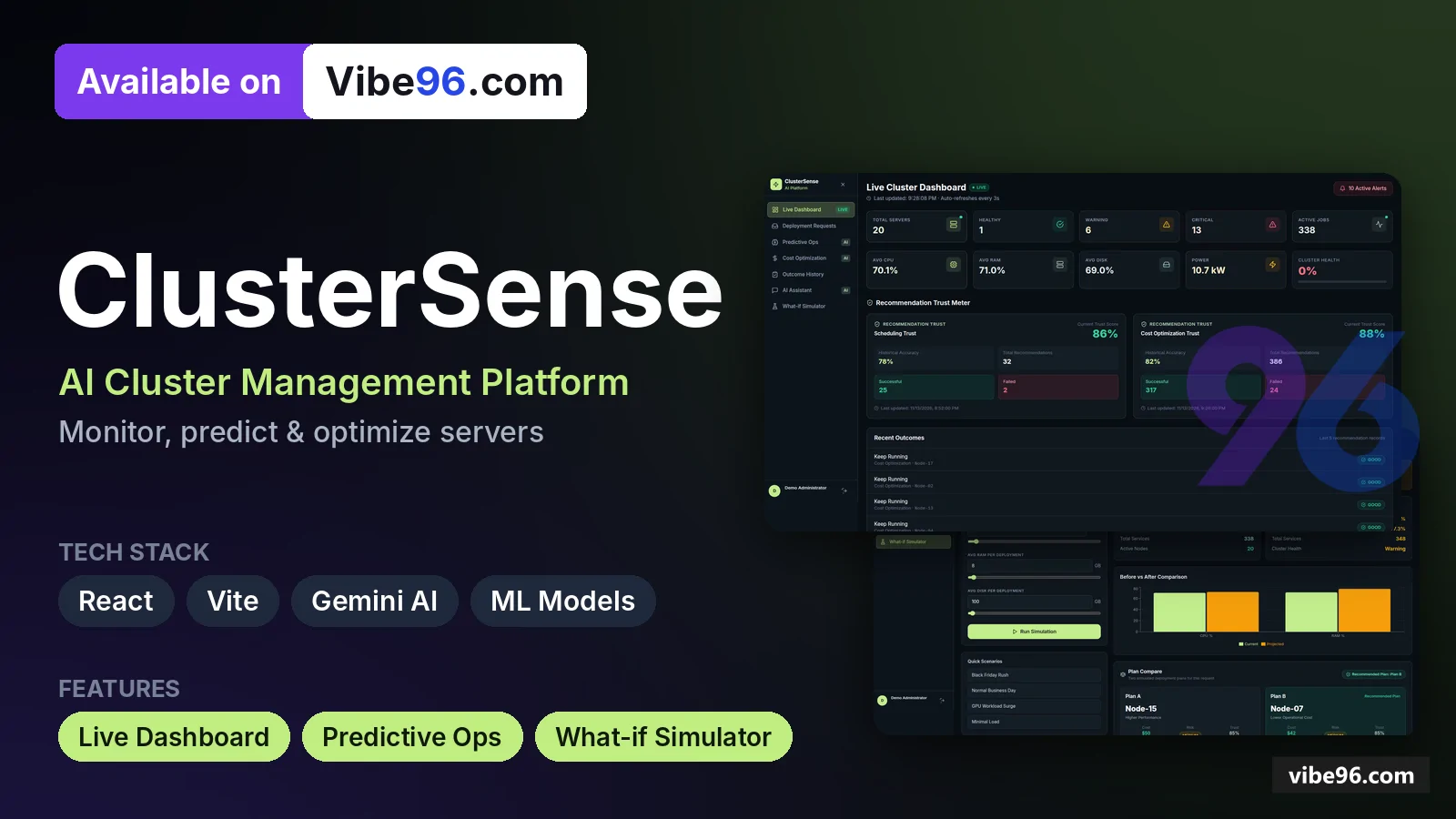
ClusterSense AI – Intelligent Cloud Infrastructure Management
Admin dashboard for hosting providers: ML node scheduling,failure prediction,cost tips and a Gemini-optional AI copilot.
- Product ID
- B1151-99934
- Builder
- Radoanul Arifen
- Version reviewed
- 1.0.0 · released 25 Nov 2026
- Stack
- FastAPI 0.111 + React 18 (Vite 5, Tailwind 3) · Python 3.11 (backend) + JavaScript (React 18 frontend) · PostgreSQL 15 (SQLAlchemy 2.0 ORM)
- Built with
- OpenAI Codex, Claude Code
- Review period
- 11 Nov 2026 – 25 Nov 2026 · 2 rounds of changes
- ✓AI code audit6 checks · 11 Nov 2026
- ✓Installed & run24 Nov 2026
- ✓Demo vs delivered24 Nov 2026
- ✓Final sign-off25 Nov 2026
At a glance
- ✓Installed and run from the delivered code — 8 of 8 checks answered yes.
- ✓Live demo compared with the delivered code — 7 of 7 checks answered yes.
- !11 of 15 promised items delivered (setup guide, example config and the rest).
- ✓Security scored 80/100 with no failing check.
- !5 open warnings — explained in part 1.
AI code audit
The full source archive was read by our AI auditor against each check. It reads the code — it does not run it; running it is part 2.
| Check | What we found | Score | Result |
|---|---|---|---|
| Secrets & credentials | All flagged candidates are CHANGE_ME placeholders, environment variable reads, hashed-password column names or localStorage token reads. No API keys, private keys or live connection strings appear in the digest. Compose enforces required secrets via ${VAR:?} so no weak defaults ship. | 96 | Pass |
| Dependency vulnerabilities | The frontend has a package-lock.json, but the backend has only a requirements.txt with direct pins and no lock for transitive packages (the README admits no audit was done). Several pinned versions have known advisories (python-jose, python-multipart, fastapi/starlette, scikit-learn, passlib/bcrypt incompatibility), which is a moderate-risk finding, not a confirmed critical production-path exploit. | 58 | Warning |
| Authorisation & access control | The visible auth code hashes passwords (passlib/bcrypt), and a test asserts every /api/ route except login and /me depends on require_admin; AGENTS.md states the same rule. However, only auth.py was provided, so the per-route guards in the 12 other routers could not be verified directly. Several smaller gaps remain: the test only checks direct dependencies, there is no login throttling, tokens are stored in localStorage, and the single-role model has no ownership checks. | 72 | Warning |
| Database access rules | The visible code (auth.py) uses parameterized SQLAlchemy ORM queries, and AGENTS.md forbids SQL concatenation. However, schema.sql, models.py, seed.sql and most API/service files were not in the excerpts, so foreign keys, indexes, cascade rules and any unscoped updates or deletes cannot be confirmed. The access model is a single administrator workspace guarded by require_admin, so per-user scoping is not required. | 72 | Warning |
| Code structure & duplication | The backend separates API routers, models, services and ML code, and the frontend splits pages, components and the API client, so the layout is navigable. The main costs are a duplicated configuration template and shared authorization logic living in the auth router, where every other router has to import it. File sizes and function lengths could not be fully verified from the excerpts provided. | 84 | Warning |
| Build reproducibility | Manifests, Dockerfiles and compose reference folders that exist, Node/Python versions are consistent, and a lockfile pins frontend packages. However, HowToSetup.md was not provided for verification of step order, Python transitive dependencies are unlocked, and some Docker details (nginx proxy, schema/seed ordering, healthcheck port) cannot be confirmed from what was shipped. | 72 | Warning |
Open warnings
Problems that did not stop the listing. They stay on the product page until a later version fixes them.
The backend separates API routers, models, services and ML code, and the frontend splits pages, components and the API client, so the layout is navigable. The main costs are a duplicated configuration template and shared authorization logic living in the auth router, where every other router has to import it. File sizes and function lengths could not be fully verified from the excerpts provided.
The visible auth code hashes passwords (passlib/bcrypt), and a test asserts every /api/ route except login and /me depends on require_admin; AGENTS.md states the same rule. However, only auth.py was provided, so the per-route guards in the 12 other routers could not be verified directly. Several smaller gaps remain: the test only checks direct dependencies, there is no login throttling, tokens are stored in localStorage, and the single-role model has no ownership checks.
The visible code (auth.py) uses parameterized SQLAlchemy ORM queries, and AGENTS.md forbids SQL concatenation. However, schema.sql, models.py, seed.sql and most API/service files were not in the excerpts, so foreign keys, indexes, cascade rules and any unscoped updates or deletes cannot be confirmed. The access model is a single administrator workspace guarded by require_admin, so per-user scoping is not required.
The frontend has a package-lock.json, but the backend has only a requirements.txt with direct pins and no lock for transitive packages (the README admits no audit was done). Several pinned versions have known advisories (python-jose, python-multipart, fastapi/starlette, scikit-learn, passlib/bcrypt incompatibility), which is a moderate-risk finding, not a confirmed critical production-path exploit.
Manifests, Dockerfiles and compose reference folders that exist, Node/Python versions are consistent, and a lockfile pins frontend packages. However, HowToSetup.md was not provided for verification of step order, Python transitive dependencies are unlocked, and some Docker details (nginx proxy, schema/seed ordering, healthcheck port) cannot be confirmed from what was shipped.
Requirement list
What the builder agreed to deliver before uploading — 11 of 15 met.
- Complete source for every component Met
- No real credentials in the archive Met
- Builds from a clean machine Partial
- Database script or migrations Met
- Authentication and roles on every mutating endpoint Partial
- Pinned dependencies without critical CVEs (nice)Partial
- Documentation set (nice)Met
- Working live demo Partial
- README.md Met
- HowToSetup.md Met
- CLAUDE.md (or AGENTS.md) (nice)Met
- CHANGELOG.md (nice)Met
- .env.example Met
- a project file Met
- a project file (nice)Met
Human review
Reviewers from the Vibe96 team in Dubai worked through each question below; a final reviewer signed it off.
Stage 1 — Installed and run from the delivered code
Completed 24 Nov 2026A reviewer installed the product on a clean machine, following only the guide that ships with it.
| Question | Answer | Reviewer's note |
|---|---|---|
| Packages restored without errors | Yes | |
| Solution builds clean | Yes | |
| Database created from the shipped script or migrations | Yes | |
| First sign-in works with the documented steps | Yes | |
| Setup guide is accurate and complete | Yes | |
| Every module in the feature list opens and works | Yes | |
| No real secrets in the archive | Yes | |
| Branding and company details can be changed without code | Yes |
Stage 2 — Live demo compared with the delivered code
Completed 24 Nov 2026A second reviewer checked that what the listing and demo show is what the buyer receives.
| Question | Answer | Reviewer's note |
|---|---|---|
| Demo URL is reachable | Yes | |
| Demo credentials work | Yes | |
| Demo runs the same version as the archive | Yes | |
| All five differentiators are visible in the demo | Yes | |
| Screenshots match the demo | Yes | |
| Nothing in the demo is missing from the code | Yes | |
| Datasheet claims are accurate | Yes |
Changes asked for during review
- None — approved on the first round.
- Sign-off: approved for sale on 25 Nov 2026 with 5 warnings shown publicly.
What this report covers — and what it doesn't
- It covers version 1.0.0 exactly as the buyer downloads it: the source archive, the setup guide and the live demo on the dates above.
- It is not a penetration test, a performance or load test, or a legal review of third-party package licences.
- Scores are a point in time. Libraries age; a later version is audited again and gets its own report.
- Your setup matters. Hosting, configuration and changes made after purchase are outside this review.
- How the score is made: each AI check is scored 0–100 and weighted (security counts most). A listing needs 75 or more, no failing check, and the human review passed.
- Always try the live demo before buying, and ask the builder questions from the product page.
Vibe96 FZ-LLC, Dubai, UAE. This report describes the product at the time of review and is not a warranty.