 Built by
About this software
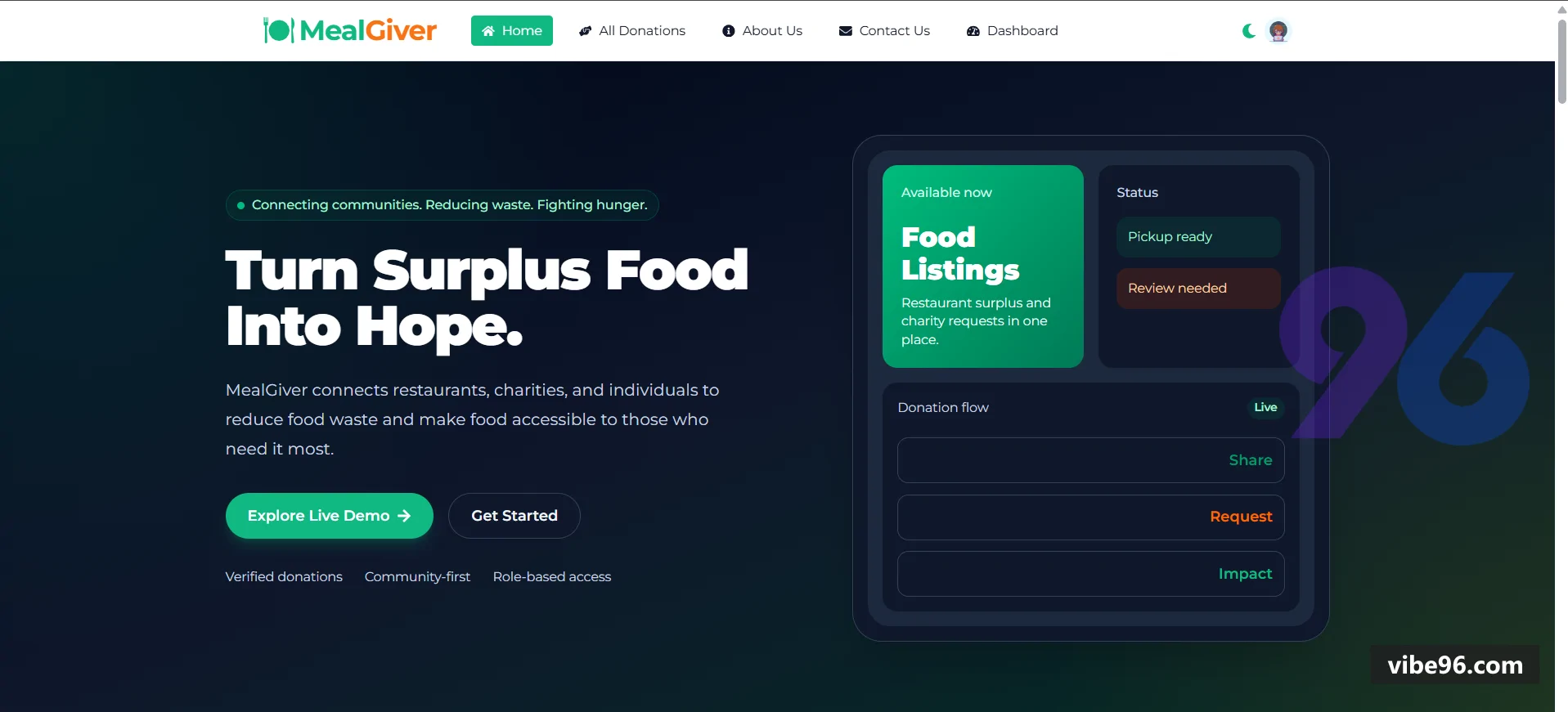
About MealGiver - Food donation marketplace connecting restaurants, charities and individuals, with admin tools.
MealGiver is a MERN-stack web application (React 19 + Vite, Express 5, MongoDB) that lets restaurants post surplus food, charities request and pick it up, and admins approve and feature listings. Sign-in uses Firebase Authentication, and the Express API verifies Firebase ID tokens and checks the user's role (admin, restaurant, charity, user) on selected routes. Charities can pay through Stripe to upgrade their role, with payments and role requests stored in MongoDB. The package includes a Docker Compose stack (MongoDB, API, Nginx-served client), database index and seed scripts, API documentation, and a backend test file covering authorization. The client has about 70 JSX components and pages, including a public site and role-specific dashboards. No mobile app is evidenced. The docs note that route validation is inconsistent and authorization is route-specific, so a security review is advisable before production.
# MealGiver – A Full-Stack Food Sharing and Donation Management Platform
## Project Overview
**MealGiver** is a modern full-stack web application developed to promote food sharing, reduce food waste, and make food donation more accessible through technology. The platform is built around a simple but meaningful idea: food that is no longer needed by one person or organization can become a valuable resource for someone else.
Every day, a considerable amount of perfectly usable food is wasted by households, restaurants, food businesses, and other establishments. At the same time, many individuals and communities face difficulties accessing sufficient food. MealGiver aims to help address this problem by providing a centralized digital platform where users can participate in food-sharing and donation activities.
Rather than allowing surplus food to go unused, MealGiver encourages people to share available food with others who may benefit from it. By bringing food donors and people interested in receiving food together, the platform helps create a more connected, responsible, and supportive community.
MealGiver is more than a conventional food-related website. It is a technology-driven initiative that combines convenience, accessibility, user management, and digital services to make food-sharing activities easier to organize and manage.
## The Problem MealGiver Solves
Food waste and food insecurity are two important challenges affecting communities worldwide. While many households and businesses regularly have excess food, other people struggle to obtain affordable and sufficient meals.
Some of the major problems include:
- **Unnecessary food waste:** Food that could still be consumed is often discarded because there is no convenient way to share it.
- **Limited donation opportunities:** People who want to donate food may not know where or how to connect with potential recipients.
- **Communication difficulties:** Coordinating food donations manually can require unnecessary calls, messages, and additional effort.
- **Lack of centralized management:** Managing food-sharing activities through separate communication channels can become confusing and inefficient.
- **Limited accessibility:** People may not know about available food-sharing opportunities in their communities.
MealGiver addresses these challenges by providing a digital environment where users can interact with the platform, access relevant services, and participate in a more organized food-sharing process.
## Main Objectives
The primary objective of MealGiver is to make food donation and sharing simpler, more organized, and more accessible.
The project focuses on several important goals:
1. **Reduce food waste:** Encourage people and organizations to share surplus food instead of unnecessarily throwing it away.
2. **Support communities:** Create opportunities for people to help others through food-sharing and donation activities.
3. **Simplify the donation process:** Provide an accessible online platform for managing food-related activities.
4. **Improve communication:** Make it easier for users to discover and participate in available food-sharing opportunities.
5. **Promote social responsibility:** Encourage generosity, kindness, and awareness of food waste.
6. **Use technology for social impact:** Apply modern web development technologies to address a real-world community challenge.
## Platform Functionality
### 1. User Authentication and Account Management
MealGiver incorporates a backend structure designed to support user authentication and account-related operations. Authentication helps establish a more secure environment where users can access the appropriate parts of the application.
The platform's account-management approach is intended to provide a personalized experience and help users interact with the services available to them.
### 2. Food Sharing and Donation Management
Food donation and sharing are at the center of the MealGiver concept. The platform is designed to make it easier to organize food-related contributions and connect available food with people who may need it.
A structured digital approach can help users manage donation information, discover available opportunities, and keep track of food-sharing activities.
### 3. Organized User Experience
MealGiver aims to provide a straightforward experience for people with different levels of technical knowledge. A clear interface and organized navigation help users understand the platform and access its available services without unnecessary complexity.
### 4. Backend API and Data Management
The application uses a dedicated backend built with Node.js and Express.js. This backend provides the foundation for handling application requests, processing business logic, and communicating with the database.
MongoDB is used as the database technology, providing a flexible approach to storing and managing application data.
The backend architecture helps separate frontend presentation from server-side operations, making the application easier to maintain, extend, and improve.
### 5. Secure and Reliable Application Services
Security and reliability are important considerations in MealGiver's development. Firebase Admin is included in the backend infrastructure to support Firebase-related administrative services, while the server-side architecture provides a centralized place to manage application operations.
Stripe is also included in the backend technology stack for payment-related integration. This provides a foundation for handling supported payment workflows securely.
## Technology Stack
MealGiver is developed using modern web technologies that work together to provide a complete full-stack application.
**Frontend – React.js**
React.js provides the foundation for building the user interface. Its component-based architecture makes it possible to develop reusable interface elements, organize application pages, and create interactive user experiences.
**Backend – Node.js and Express.js**
Node.js provides the server-side JavaScript runtime, while Express.js is used to develop backend routes and APIs. Together, they handle application requests, business logic, and communication between the frontend and database.
**Database – MongoDB**
MongoDB stores application information in a flexible document-oriented structure. It supports the management of user and application data.
**Authentication and Administrative Services – Firebase Admin**
Firebase Admin is integrated into the backend to support Firebase administrative functionality.
**Payment Integration – Stripe**
Stripe is included in the backend infrastructure to support payment-related functionality and secure payment processing workflows.
**Deployment – Vercel**
The MealGiver frontend is deployed on Vercel, making the application accessible through a public web address.
## Why MealGiver Matters
The value of MealGiver extends beyond its technical implementation. The project demonstrates how web technologies can be used to encourage positive social behavior and address everyday challenges.
By promoting food sharing, the platform supports the idea that small contributions can create meaningful results. A household sharing excess food, a business contributing surplus meals, or an individual participating in a donation initiative can all become part of a larger community effort.
MealGiver encourages a shift from unnecessary food disposal toward responsible food utilization. It also demonstrates how digital platforms can help people coordinate meaningful activities more efficiently.
## Future Development Opportunities
MealGiver provides a foundation that can be expanded with additional features and services as the project evolves.
Potential improvements include:
- Location-based food discovery to help users find nearby sharing opportunities.
- Real-time notifications for donation updates and important activities.
- Advanced search and filtering for food categories and availability.
- Donation tracking and detailed activity histories.
- Improved analytics to measure food-sharing activities and community impact.
- More advanced administrative tools for managing users and platform operations.
- Additional payment-related features where applicable.
- Improved accessibility and responsive experiences across mobile, tablet, and desktop devices.
## Conclusion
MealGiver represents the combination of modern full-stack web development and a meaningful social initiative. By focusing on food sharing, donation management, and community participation, the project aims to make it easier for people to contribute toward reducing food waste and supporting others.
Built with React.js, Node.js, Express.js, MongoDB, Firebase Admin, and Stripe, the application demonstrates the use of modern technologies to develop a practical, scalable, and purpose-driven digital solution.
Ultimately, MealGiver is built around one meaningful belief: **food should be shared whenever possible, not wasted unnecessarily.**
Through technology, collaboration, and community participation, MealGiver aims to help create a future where surplus food can become an opportunity to support someone else.
Why MealGiver - Food donation marketplace connecting restaurants, charities and individuals, with admin tools.
What makes it better
than the alternatives
- 01
Four-role access model
Backend middleware distinguishes admin, restaurant, charity and user, with ownership checks on donation and request routes covered by tests.
- 02
Stripe-backed charity upgrade
A payment-intent endpoint, transaction records and a charity role-request flow with admin review are included.
- 03
Docker-ready deployment
Compose file runs MongoDB with an app user, the API with a health check, and an Nginx client proxying /api.
- 04
Database tooling included
Index/validator setup script and a development-only seed script ship alongside setup documentation.
- 05
Documented and tested API
Docs/api.md, a README endpoint reference, CLAUDE.md guidance and an authorization-focused API test suite are provided.
Authentication & Roles
- Firebase email/password and Google sign-in
- Password reset email
- Private route guard on the client
- Bearer ID-token verification on the API
- Admin role assignment and user deletion
Restaurant Donations
- Add donation form
- My donations list with update and delete
- Unapproved-by-default new listings
- Requested donations view
- Restaurant profile and edit pages
- Restaurant stats endpoint
Charity Workflow
- Request donations via modal form
- My requests and my pickups
- Received donations
- Charity profile
- Transaction history
- Request-status counts
Admin Dashboard
- Manage users
- Manage donations and feature donations
- Manage requests
- Manage role requests
- Admin profile and platform stats
Public Site
- Home page with banner
- featured donations
- impact stats and community stories
- All donations browsing
- Donation details page
- About
- Contact
- FAQ
- services
- newsletter and partners sections
- Branch coverage map with district search
User Features
- Favorites
- Reviews and My Reviews
- User dashboard and profile
Payments
- Stripe Elements on the client
- Server-side payment intent creation
- Transaction recording
Deployment & Data
- Docker Compose with MongoDB
- API and Nginx client
- Vercel config for API and Firebase Hosting config for client
- Index setup and seed scripts
- Health endpoint
| Language | Version | Framework | Used for | Share of code |
|---|---|---|---|---|
| JavaScript (React) | — | — | Front-end | 67.3% |
| JavaScript | — | — | Front-end | 32% |
| CSS | — | — | Styling | 0.5% |
| Shell | — | — | Scripts | 0.1% |
| HTML | — | — | Front-end | 0.1% |
- Primary language
- JavaScript (ES2020+) on Node.js 22.12+
- Framework
- React 19 + Vite 7 (client); Express 5 (API)
- Database
- MongoDB 8 (Compose image) via official Node driver 6
- Authentication
- Firebase Authentication (email/password, Google sign-in, password reset); backend verifies ID tokens with Firebase Admin SDK
- Licence
- Single-site
- Screens
- 35
- Database tables
- 8
- Supported languages
- English only; no i18n library in the digest. RTL not supported.
- Browser support
- Modern evergreen browsers (Vite 7 default targets); no explicit browser list in the digest
| Minimum | Recommended | |
|---|---|---|
| CPU | 1 vCPU | 2 vCPU |
| RAM | 1 GB | 2 GB |
| OS | Linux (Alpine containers); Node.js 22 (22.12+ for client build); MongoDB 8 | Linux (Alpine containers); Node.js 22 (22.12+ for client build); MongoDB 8 |
| Est. monthly hosting | $15 | $15 |
```sh
cp .env.example .env
# edit .env: set MongoDB, Stripe, Firebase and VITE_* values
docker compose up -d --build
```

Only the client port (default 8080) is exposed; MongoDB and the API stay on the internal network. Then run `node database/indexes.js` to create indexes and validators.
```sh
cd mealgiver-server
npm ci
npm start

cd ../mealgiver-client
npm ci
npm run build
```

Serve `mealgiver-client/dist/` with a static server that rewrites unknown paths to `/index.html`. Set `PORT`, `HOST`, `MONGODB_URI`, `STRIPE_SECRET_KEY` and `FB_SERVICE_KEY` in the server environment.
The API folder includes `vercel.json` for Vercel routing. Deploy `mealgiver-server/` to Vercel with its environment variables set. Build `mealgiver-client/` with `npm run build` and host `dist/` on any static host, setting `VITE_API_BASE_URL` to the API origin.
Quality report
Manually reviewedHow to read the quality report
What this is. Every project on Vibe96 goes through an automated audit of its source code before a reviewer in Dubai checks it by hand. The score is out of 100; 75 is the minimum to be listed, and any single failing check blocks a listing regardless of the score.
- Security
- No real credentials in the code, every data-changing route protected, admin areas role-gated, no SQL built from user input.
- Code structure
- A developer can navigate and extend it: clear module boundaries, no giant files, little copy-paste.
- Docs & completeness
- The setup guide, example config, schema and required files the builder committed to are actually in the archive.
- Dependency health
- Packages pinned, no known critical vulnerabilities, no abandoned libraries in production paths.
- Build & deploy
- A clean machine can restore, build and start it by following the shipped instructions.
Warnings are problems that didn't block the listing; they stay visible here until a later version clears them. The audit reads the code — it does not run it — so always try the live demo before you buy. Lines of code are counted from the same audited archive.
Reviewer notes (5 minor)
Small improvements the developer has been told about. None of them stop the software from working.
Versions & updates
No updates yet. New versions appear here with a changelog.
Buyers receive updates free for 1 year.
What you get
- </>Full source codeThe complete audited source, delivered as a download from your account. No obfuscation.
- ▤DocumentationSetup guide, architecture notes, CLAUDE.md and AGENTS.md.
- ↻No updates or supportA free download is the current version as it is. Updates and builder support come with a paid licence.