Once a business accepts that AI coding tools can produce a working application quickly, the next decision is whether to use one to build from scratch, or to buy source code online for a project that already exists and is close to what is needed.
Both are legitimate paths, and plenty of teams make either choice successfully. The right one depends less on budget alone and more on how close an existing project gets you to your actual requirements, and how much time you realistically have before you need something live and usable.
This decision also tends to get revisited partway through a project, once the real cost of either path becomes clearer than it looked at the start, so it is worth thinking through honestly rather than defaulting to whichever option feels more familiar. Teams that skip this comparison entirely, and simply default to building because an AI coding tool makes it feel free, are often the ones who end up paying the most in the end, in time if not in money.
What building a vibe-coded app from scratch actually takes
Building from zero with an AI coding tool removes a lot of the typing, but it does not remove the thinking. Someone still has to define the data model, the user flows, the edge cases and the integrations, then describe all of that clearly enough for the tool to produce something usable. For a simple internal tool this might take a few days. For anything with real business logic, payments, multi-user permissions or external integrations, it can stretch into weeks, and the first working version is rarely the production-ready one, no matter how capable the AI tool is.
There is also a learning curve to directing these tools effectively. Getting consistently good output requires knowing how to break a large request into smaller, well-specified pieces, how to review generated code critically rather than accepting it at face value, and when to step in and fix something by hand rather than trying to prompt your way around it.
What buying an existing vibe-coded app gets you
Buying an existing project skips the discovery and first-draft phase entirely. A listing on an AI built software marketplace typically already handles the core workflow for its category, whether that is a CRM pipeline, an inventory system or a booking flow, and has been through some form of review before it was listed. You are not starting from an empty prompt; you are starting from a working baseline you can inspect, test and then adjust to your own needs, which is a fundamentally different starting position.
Comparing cost and time honestly
Building from scratch with an AI tool is often cheaper in direct cost, since there is no purchase price, but it hides its real cost in the hours spent specifying requirements, testing, and fixing what the tool got wrong along the way. Buying off the shelf business software has an upfront price, but that price buys you a project that has already absorbed the first, most expensive round of that iteration. For a team on a tight deadline, this difference tends to matter more in practice than the sticker price alone suggests on paper.
When building from scratch makes sense
Building is usually the better call when:
• The requirements are unusual enough that no existing project is close to a fit
• The team has developers available to review and guide the output
• There is no hard deadline pushing toward something usable this week
• The long-term plan involves significant, ongoing custom development anyway
When buying makes more sense
Buying tends to win when:
• An existing category, such as CRM or e-commerce, already covers most of the need
• Speed to a working, demoable product matters more than a perfect fit
• The team would rather spend its time customizing than starting from zero
• Budget is better spent on targeted expert help than on a full build
Questions worth asking before you decide
A short set of questions tends to clarify which path actually fits a given project:
• How close is the nearest existing listing to what we actually need, honestly rather than optimistically
• Do we have developers available to review AI-generated output if we build it ourselves
• What does the deadline realistically allow for, once testing and fixes are accounted for
• Would the money spent on a full custom build be better spent buying a close match and customizing it
Writing the answers down, rather than deciding on instinct in a planning meeting, tends to surface the real constraint driving the decision, whether that is time, budget, or the simple fact that nobody on the team has used an AI coding tool before.
A middle path: buy, then customize
Many teams land somewhere between the two extremes. They buy an AI coded app that covers the core of what they need, then use their own AI coding tool, or a short engagement with a developer, to adjust it to their workflow. This keeps the speed advantage of buying while still allowing the final product to diverge from the original listing where it genuinely needs to, without paying the full cost of building everything from first principles.
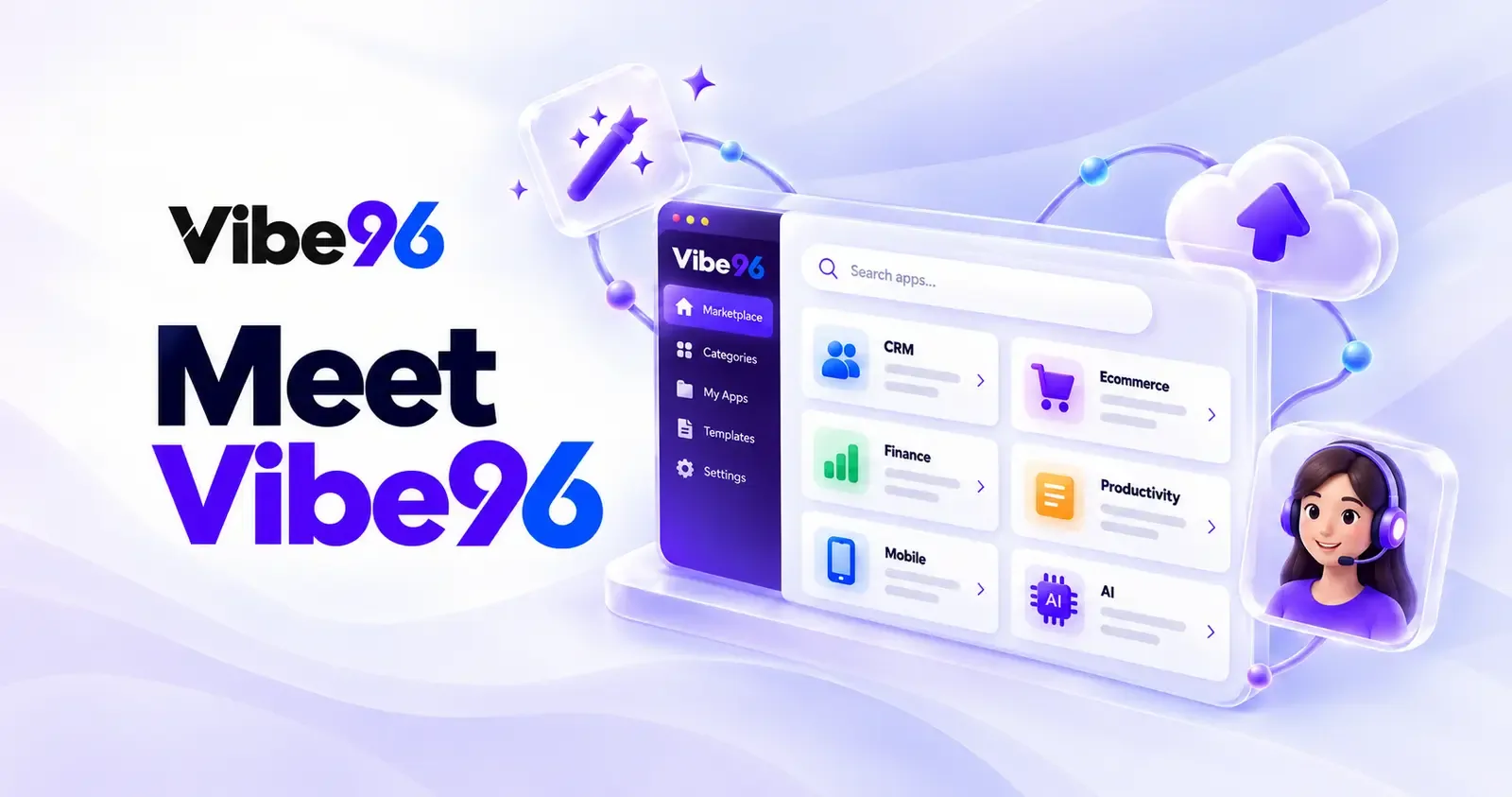
Browsing Vibe96's Vibe Coded AI App Marketplace by category is usually the fastest way to find out whether a close-enough starting point already exists before committing to a build from scratch.
Neither buying nor building is the correct answer on its own. The more useful question is how far an existing project gets you toward what you actually need, and whether the gap is small enough to close through customization rather than a full rebuild. Answering that honestly, before committing budget or a deadline to either path, saves most of the regret that comes from guessing and discovering the real cost too late.