Vibe coding means building software by describing what you want in plain language and letting AI write the code. For business owners it is the biggest shift in software since the smartphone: an idea that once needed a development team and three months can now become a working app in a day. Vibe96 and its AI builder Vibe Studio were created to make vibe coding dependable enough to run a business on.
Where the term came from
AI researcher Andrej Karpathy coined the phrase in a post on 2 February 2025, describing "a new kind of coding I call 'vibe coding', where you fully give in to the vibes" — Merriam-Webster now credits him with the term. By November 2025, Collins Dictionary had named "vibe coding" its Word of the Year, defined as "the use of artificial intelligence prompted by natural language to assist with the writing of computer code."
The adoption has been just as fast. Y Combinator said about a quarter of its Winter 2025 startups had 95% of their code written by AI. Gartner predicts vibe-coding tools will create 40% of new production software by 2028. And one vibe-coding platform alone reported about 1 million new projects every week.
Why business owners should care
For an owner, vibe coding changes three things:
1. Cost. You no longer pay for every screen to be hand-built. The expensive part becomes deciding what you want.
2. Speed. You can see a working version the same day and change it the same afternoon.
3. Control. You are no longer waiting in an agency's queue. You make the change yourself, in words.
The UAE alone has around 1.2 million companies, 94% of them SMEs, and a goal of 2 million companies by 2031. Most of those businesses need a website, booking, ordering or a customer app — and very few have a development team.
Where vibe coding goes wrong
Vibe coding has a reputation problem, and it is earned. AI writes code that looks right more often than it is right:
• Veracode found 45% of AI-generated code samples contained security flaws.
• In the Stack Overflow 2025 survey, 66% of developers said their biggest frustration is AI answers that are "almost right, but not quite".
• Experienced developers also mostly keep it out of serious work: 72% said vibe coding is not part of their professional work.
For a business owner, "almost right" means a checkout that charges the wrong total, a booking system that double-books, or customer data that anyone can see. That is why most vibe-coded projects stay demos.
A day in the life: from idea to live app
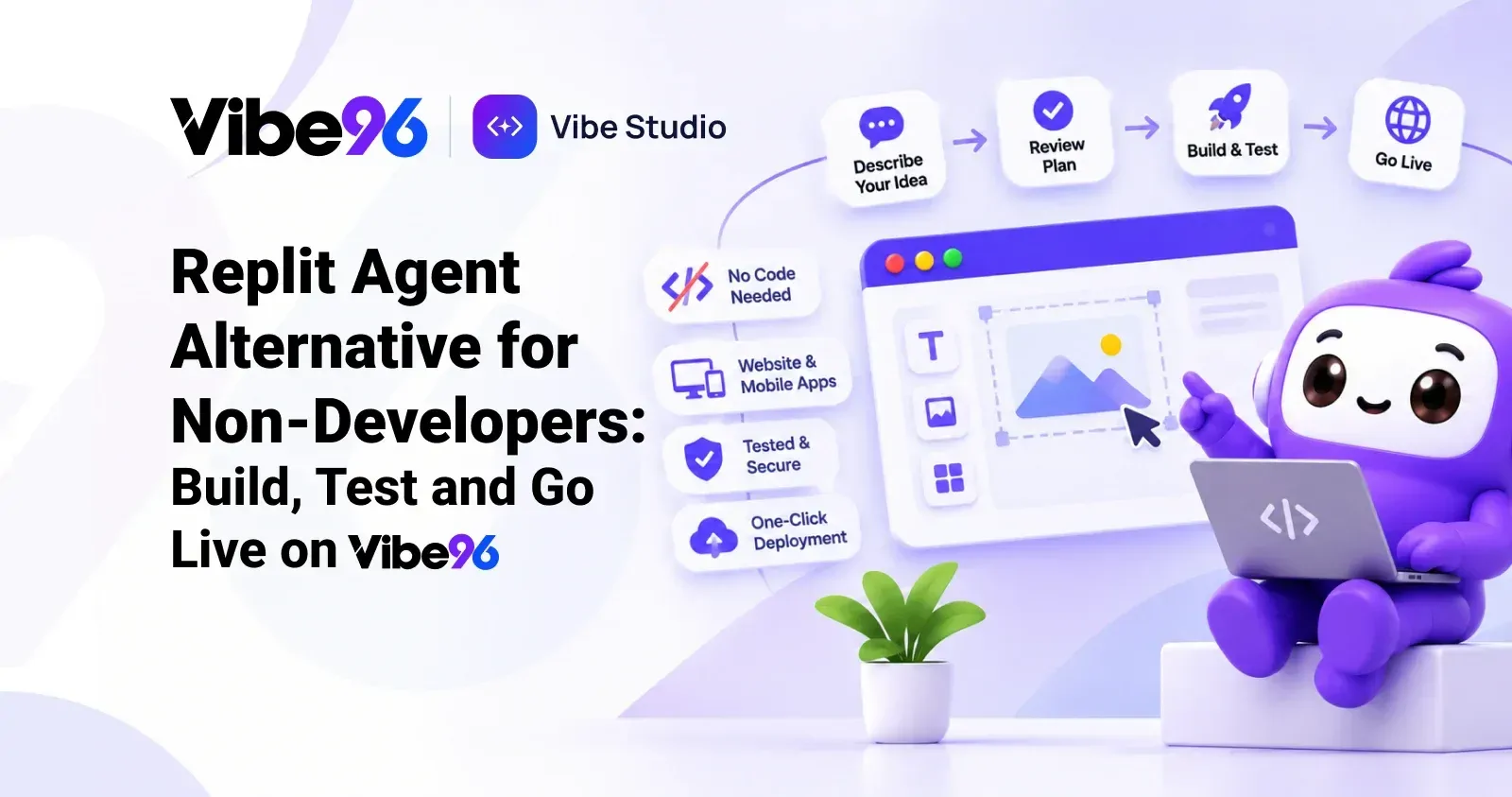
Here is how a real day looks for a business owner on Vibe96.
9:00 — Describe the idea. A Dubai florist writes four lines in Vibe Studio: online shop with categories and occasions, delivery time slots, a customer app and a driver app, an admin panel with revenue in AED.
9:10 — Answer questions. Nova asks about payments, delivery fees, add-ons and contact details. The owner answers in one message.
9:20 — Approve the plan and pick a look. The plan lists every page, the user roles and 26 features. The owner removes one, adds one, approves, and picks the "Evergreen Velvet" look from three options.
9:25 — Develop. The owner chooses Signature mode for the first build. The AI team installs the shop, payments and delivery modules and builds the rest. Progress messages arrive: "Brand, theme and website home — done", "Orders API with slots and tracking — done".
10:00 — Test. The test link is ready. The owner clicks through the shop on their phone, signs in to the admin panel with the login from Project settings, and runs use-case tests. Two small changes are requested in chat.
Afternoon — Refine. A second Develop adds the change requests. The owner edits a few texts directly with the visual editor and builds an Android test app to try on a real phone.
17:00 — Go live. The owner presses Go live, chooses an address and a plan, and shares the link with the first customers.
What it costs
There is no subscription. You top up a Vibe96 wallet and each Develop run costs at most $10 (Spark, about 5 minutes), $15 (Shape, about 15 minutes) or $25 (Signature, about 30 minutes). Hosting starts at $5 a month when you go live. Android builds include 10 free builds a month.
Tips for vibe coding like a pro
• Describe outcomes, not screens. "Customers can re-order their last bouquet in two taps" beats "add a button".
• Name your users. Customers, staff, drivers, admins — each gets the right access.
• Give real details. Prices, fees, opening hours and contact details go straight into the app.
• Approve carefully. The plan is cheap to change; built features cost a Develop run.
• Test like a customer. Use the use-case tests and try the app on your own phone.
• Start small, then grow. Launch the core, then add loyalty, reviews or invoices later — each is a ready-made module.
See the full flow in the Vibe Studio tutorial video.
Frequently asked questions
What is vibe coding? Vibe coding is building software by describing it in natural language and letting AI write the code. The term was coined by Andrej Karpathy in February 2025 and was Collins Dictionary's Word of the Year for 2025.
Is vibe coding safe for a real business? It can be, if the platform adds planning, tested building blocks, security checks and testing. Vibe96 was designed around those safeguards.
Can a non-technical person build an app with vibe coding? Yes. On Vibe96 you describe the business, approve a plan and test the result; Vibe Studio handles the code.
What is Vibe Studio? Vibe Studio is Vibe96's AI app builder at studio.vibe96.com.
Start building: Turn your idea into an app today on Vibe96 →