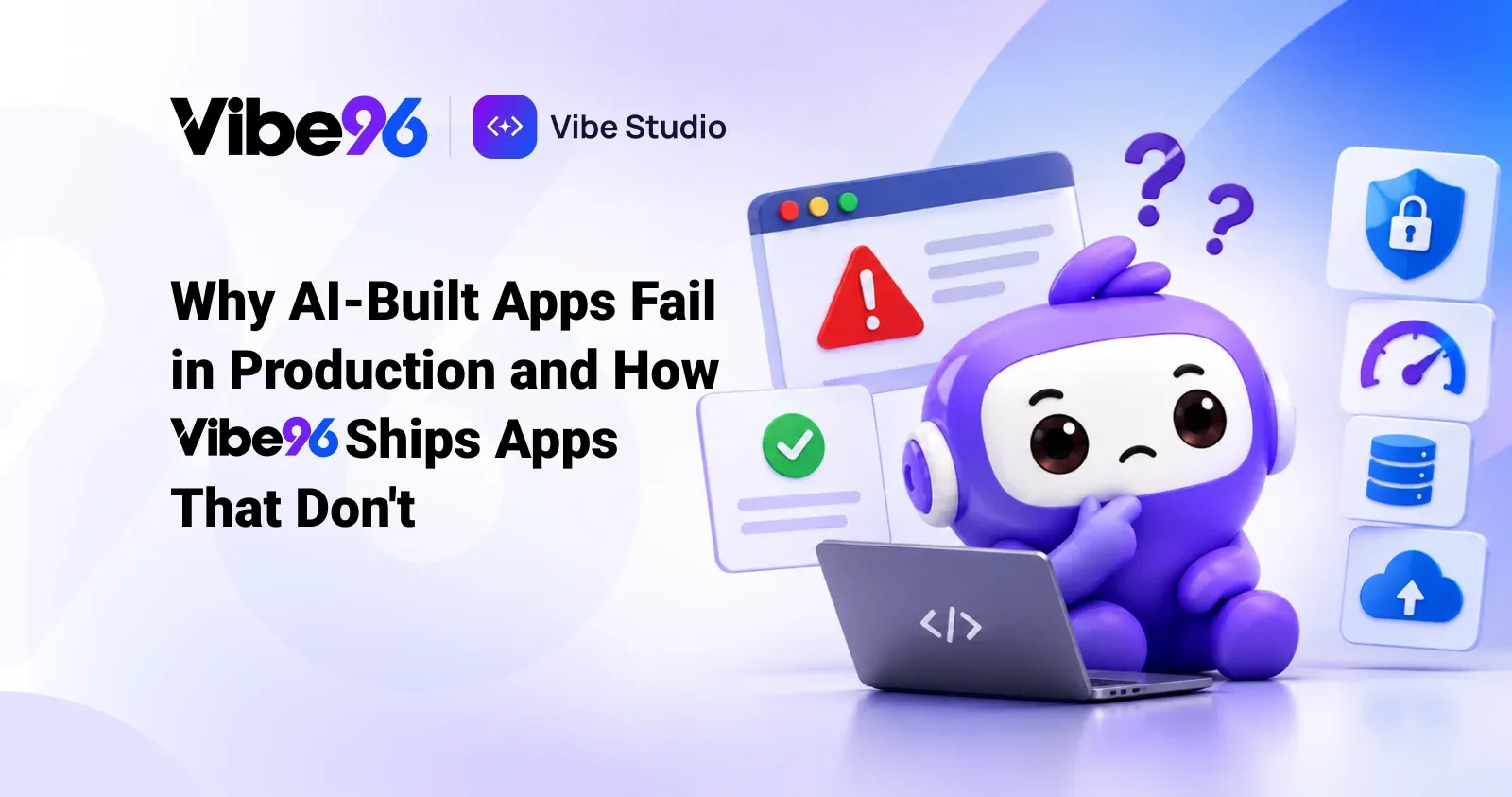
AI-built apps usually fail in production for the same few reasons: missing security checks, untested edge cases, no real database design, no backups or monitoring, and code nobody reviewed. Vibe96 was designed around those failures — its builder Vibe Studio uses tested modules, security reviews, real-user testing and managed hosting so the app that worked in the demo keeps working with customers.
The demo-to-production gap
Vibe coding has gone mainstream. Collins Dictionary named it Word of the Year for 2025, and Gartner expects vibe-coding tools to create 40% of new production software by 2028.
But professional developers remain careful. In the Stack Overflow 2025 Developer Survey, 72% said vibe coding is not part of their professional work, 46% distrust the accuracy of AI output, and 45% find debugging AI-generated code time-consuming.
The reason is simple: a demo only has to work once, for one person, on a good connection. Production has to work every time, for everyone, under pressure.
Failure 1: Security holes
What happens: Veracode tested more than 100 AI models on 80 coding tasks and found 45% of the generated code contained security flaws from the OWASP Top 10. Cross-site scripting defences failed 86% of the time. A Stanford study found people using AI assistants wrote less secure code and were more confident it was secure.
Typical results: admin pages that anyone can open by typing the URL, customers who can see other customers' orders by changing a number, API keys left in the browser code.
How Vibe96 prevents it:
• Sign-in, roles and permissions come from a tested foundation, not from a prompt.
• Every admin route and API checks the user's role on the server.
• Shape and Signature builds include a security review by a separate AI pass that looks for exactly these problems.
• Secrets (payment keys, database passwords) live in server settings, never in the app's code — and Vibe Studio removes them from its own job records after use.
Failure 2: Data that goes wrong under real use
What happens: Two customers buy the last item at the same time and both succeed. A booking slot is double-booked. A payment arrives a second after the order was cancelled.
How Vibe96 prevents it: Vibe96's shop, booking and delivery modules lock stock and capacity in the database. In our own tests, ten people trying to buy the last three items always produce exactly three orders. Payment and cancellation are handled so a late payment never meets a cancelled order silently.
Failure 3: No real database design
What happens: Many prototypes store data in a quick, loose structure. It works for ten records and becomes slow, inconsistent or impossible to report on at ten thousand.
How Vibe96 prevents it: Every Vibe96 app runs on a real relational database (PostgreSQL, MySQL or SQL Server depending on the stack) with proper tables, relations, indexes and migrations. Reports, exports and admin search work from day one.
Failure 4: Slow pages
What happens: Google research found 53% of mobile visitors leave a page that takes longer than 3 seconds to load. AI-generated pages often load huge images, fetch data one item at a time, or ship the whole app to the browser.
How Vibe96 prevents it: Pages are rendered on the server where possible, images are resized, lists are paginated, and database queries are built for the screen that uses them. Hosting includes caching and compression.
Failure 5: Mobile app crashes
What happens: A recent report found 15.4% of users uninstall an app after a single crash, and over half abandon it after two or three. Web-view wrappers and untested native code crash on real devices.
How Vibe96 prevents it: Vibe96 mobile apps are built with Expo and React Native — the framework the React Native team calls "the only recommended community framework". Screens share the same tested API as the website, and apps handle poor signal (for example, the delivery driver app saves changes offline and sends them later).
Failure 6: Nobody tested it like a customer
What happens: The builder checked that the code compiles. Nobody tried to sign up, pay, cancel, and get a refund. Poor software quality cost the US economy at least $2.41 trillion in 2022, according to CISQ.
How Vibe96 prevents it: Vibe Studio runs use-case tests: it uses your app like a real customer or admin would — opening pages, filling forms, placing orders — and reports what passed and what failed, with screenshots. Each test costs $0.25. Read Use-Case Testing Explained (Article 16).
Failure 7: No hosting plan after launch
What happens: The app is exported to a cheap server with no backups, no SSL renewal, no monitoring. It goes down at 2 a.m. and nobody notices until customers complain. 57% of organisations said their most recent major outage cost over $100,000.
How Vibe96 prevents it: Go live in one click from $5 a month, with your own domain, automatic SSL, daily backups, uptime monitoring and alerts.
Why the module approach matters
Most AI builders generate everything from scratch each time. That means the payment flow, the sign-in and the order logic are new, untested code in every project.
Vibe96 takes a different approach. Common features — payments, shop, bookings, delivery, notifications, invoices, reports, coupons, reviews, Arabic — come from tested modules that have been built, reviewed and exercised many times. The AI then builds what makes your app unique on top. You get the speed of AI with the reliability of proven code. Read more in How Vibe96 Keeps AI-Built Apps High Quality (Article 15).
See it in action in the Vibe Studio tutorial video.
Frequently asked questions
Are AI-built apps safe for real customers? They can be, if security is built in rather than left to chance. Vibe96 uses tested sign-in and permissions, a security review on Shape and Signature builds, and keeps secrets out of the code.
Why do vibe-coded apps break after launch? Usually because of untested edge cases, missing permission checks, weak database design and no monitoring. Vibe96 addresses each of these by default.
Can I see the code Vibe96 writes? Yes. You can download the full source code at any time.
Start building: Build an app that's ready for real customers on Vibe96 →