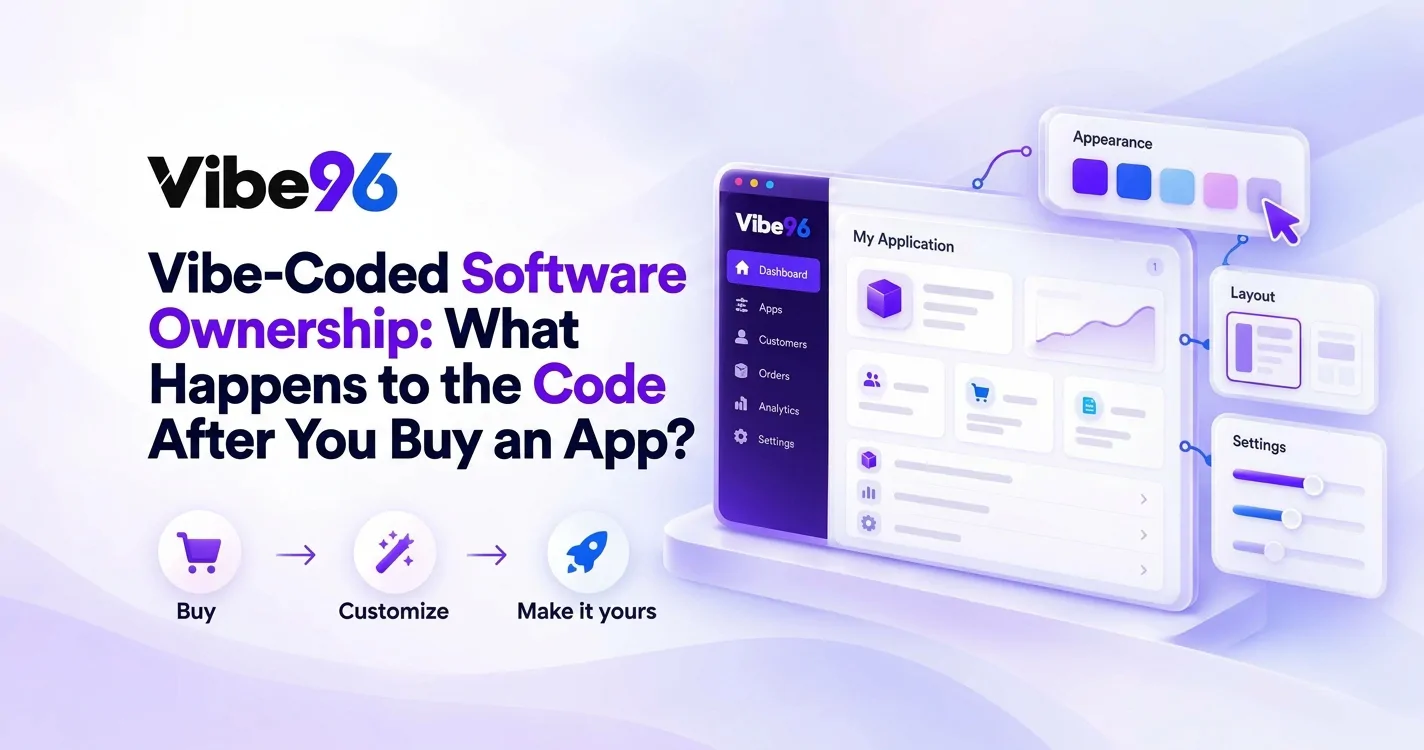
Buying software off a marketplace does not mean living with it exactly as listed. Because the full source code comes with the purchase, a vibe-coded app is closer to a starting point than a finished, locked product, which raises the practical question of how much customization is realistically possible and who should actually do it.
This is one of the most common questions first-time buyers have after a purchase, and the short answer is yes, almost always, with the longer answer depending on what exactly is being changed and how much risk that change carries if it goes wrong.
Why source code access changes the equation
A SaaS subscription limits you to whatever settings the vendor exposes. Owning the source code removes that ceiling entirely. Branding, workflow steps, field names, even entire features can be changed, because nothing about the application is hidden behind someone else's platform. The only real constraints are the stack the project was built on and how much time or budget is available to make the changes.
This is often the single biggest reason buyers choose a marketplace purchase over a SaaS subscription in the first place, even when the subscription might look cheaper month to month. The ceiling on what you can eventually build the product into is simply higher when nothing is locked behind someone else's roadmap.
Customizing it yourself with an AI coding tool
For most listings, the simplest path to customization is the same kind of tool that built the project in the first place. Since listings document which AI coding tool and stack they used, picking a compatible tool for a vibe coding tools comparison is straightforward: using the same one the original project was built with tends to produce the smoothest results, since the tool is already familiar with similar project structures.
In practice, this means pointing the AI coding tool at the existing codebase and describing the change you want, the same way you would direct it on a new project, except now it has real, working code to read and extend rather than a blank file to start from.
What kinds of changes are realistic to make this way
• Branding, copy and layout adjustments
• Adding or changing fields in an existing data model
• Adjusting workflow states or notification rules
• Connecting a tool you already use, where an integration point already exists
• Adjusting permissions or roles to match how your team is actually structured
Each of these is a bounded, well-understood kind of change, which is exactly the kind of task an AI coding tool tends to handle reliably when it has existing, working code to build from.
When to bring in a developer instead
Not every customization is safe to attempt casually with an AI coding tool, particularly anything touching authentication, payment processing, or a migration of existing data. An AI app customization service, delivered by an experienced developer rather than attempted solo, is the more reliable path for these, since the cost of a mistake, a broken checkout or an exposed account, is far higher than the cost of a short, scoped engagement.
What a developer engagement for customization typically looks like
A request to hire expert for vibe coded project work usually starts with a description of the change needed, followed by a fixed-price quote rather than an open-ended hourly estimate. This keeps the scope contained and makes it easy to decide whether the change is worth the cost before committing, rather than discovering the total only after the work is already underway.
This structure also protects the buyer from scope creep, since the quote is tied to a specific, described change rather than an open hourly rate that can expand quietly as the work progresses.
Combining both approaches on one project
Most buyers end up using both paths on the same project: handling cosmetic and workflow changes themselves with an AI coding tool, and bringing in a developer for the handful of changes that carry real risk if done poorly. This keeps costs down without exposing the project to the kind of mistake that is expensive to undo. Over time, this also tends to be the pattern that produces the healthiest codebase, since the riskiest changes get the most scrutiny while the routine ones move quickly.
Where to find help scoped to your stack
Finding someone who hire someone to customize my software style requests go to, matched specifically to the stack a project was built on, saves the time of explaining the codebase from scratch to an unfamiliar freelancer.
Vibe96's Vibe Coded AI App Marketplace connects buyers with developers already vetted against the stacks its listings are built on, which shortens the gap between deciding a change is needed and actually getting it done.
A reasonable way to sequence customization work
Rather than listing every desired change at once, it tends to work better to launch with the core purchase mostly as-is, gather real feedback from actual use, and then customize based on what genuinely turns out to matter. This avoids spending time and budget changing things that, once the application is actually in use, nobody ends up caring about, and it keeps the first launch closer to the proven version the listing's audit and demo were based on.
Yes, a vibe-coded app can be customized after purchase, and for most buyers it eventually is. The practical question is not whether customization is possible, since owning the source code guarantees that, but which changes are safe to make with an AI coding tool directly and which are worth a short, scoped developer engagement instead.