“Vibe coding” has become the shorthand for building software by describing what you want in plain language and letting an AI coding tool write, test and often run the code for you. It is not a single product or company. It is a way of working that has spread quickly across a new generation of coding assistants, and it has changed how fast a working prototype can go from an idea in someone's head to something a user can click through.
If you have seen the term and wondered what is vibe coding in practice, the short answer is that it shifts most of the typing from a human developer to an AI model, while a person still directs the work, reviews what comes out, and decides what actually ships.
The idea sounds simple, and in small doses it is. The more interesting question, and the one worth spending real time on, is how does vibe coding work once a project grows past a weekend experiment, what the current tools actually do differently from one another, and what has to happen before that code is trusted with real users and real data.
How vibe coding actually works
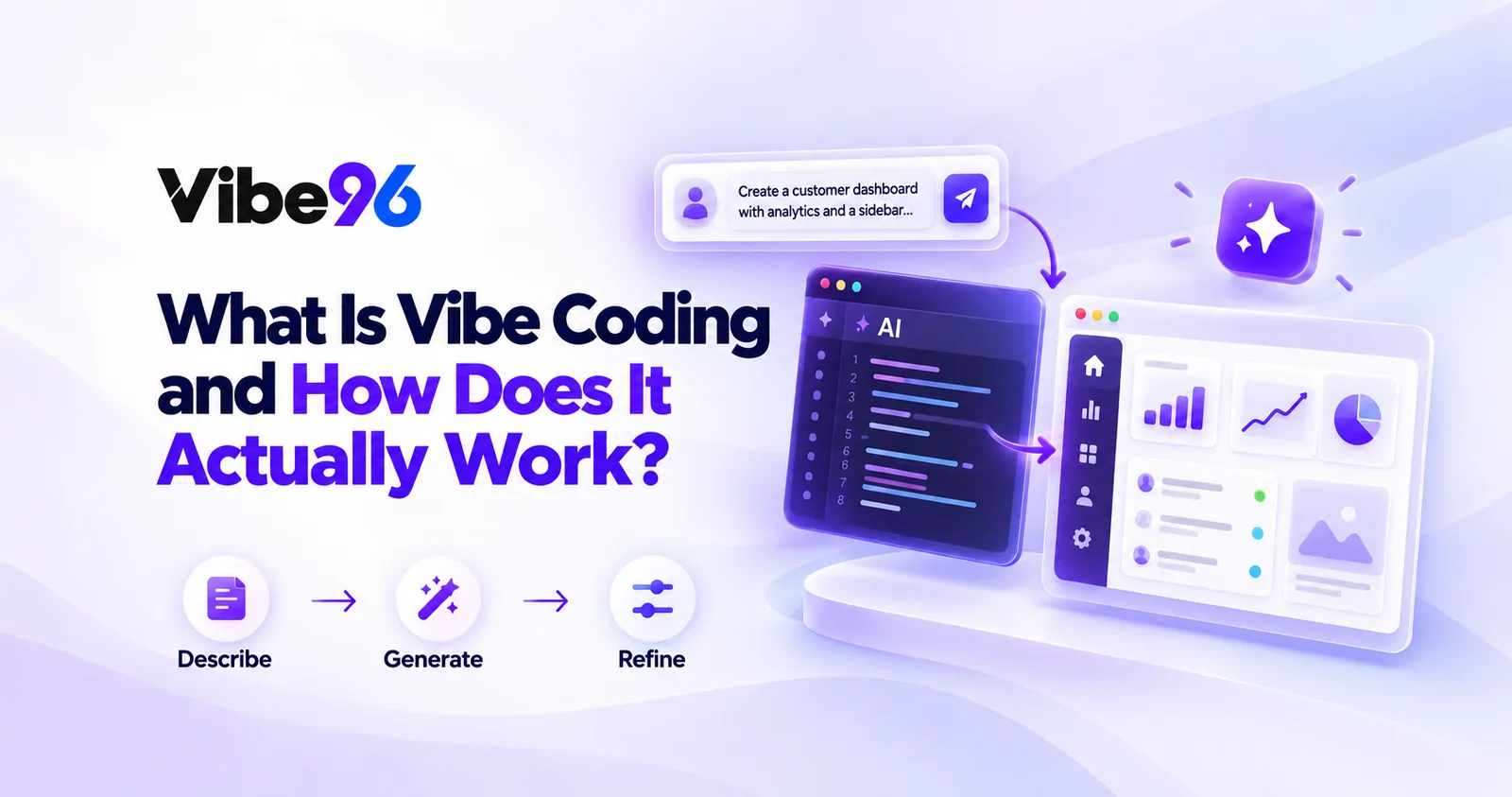
At its core, vibe coding follows a loop. A person describes a feature or an entire application in natural language, an AI coding tool generates the code, the person runs it, and feedback goes back into the next prompt. Modern tools extend this loop with their own file access, so they can create multiple files, run tests and fix errors without constant copying and pasting between a chat window and an editor.
Some tools work directly in a terminal and can execute commands on your behalf, reading error output and correcting course without being asked each time, almost like a junior developer working through a ticket. Others work inside a browser and show a live preview as the application takes shape, which suits people who are not developers and want to see progress visually rather than in a log. The common thread across all of them is that the AI model holds most of the implementation detail, while the person steers direction, scope and quality. The quality of the final result still depends heavily on how clearly that person communicates what they actually want, and how carefully they check what comes back.
The tools behind vibe coding in 2026
Explaining how vibe coding works usually means naming the tools people are actually comparing when they search for vibe coding tools 2026. Claude Code and Cursor are popular with developers who want an AI assistant layered over a familiar coding environment they already understand, since both can read an existing codebase, make changes across several files, and run tests before handing control back. Replit and Bolt.new lean toward complete, hosted environments where someone without a development background can go from an idea to a working web app without installing anything locally, which lowers the barrier to entry considerably.
Lovable, Windsurf, Kiro, Trae, v0 and OpenAI Codex each take a slightly different angle, some focused on design-led interfaces that prioritize how an app looks before how it behaves, others on longer, multi-step agentic tasks that touch many files at once and can run for extended periods with minimal supervision. None of these tools produce identical code from the same prompt, which is part of why a buyer or a hiring manager often wants to know which vibe coding tool built a given project before deciding how to work with it afterward, since each has its own habits, strengths and blind spots.
Is vibe coding safe?
This is one of the most searched questions around the category, and the honest answer is that it depends on what happens after the code is generated, not on the method itself. AI coding tools can introduce real problems without flagging them as problems, simply because the model optimizes for working output rather than for defending against every possible misuse.
• Hardcoded API keys or credentials left inside the source
• Authorization checks that look correct but were never actually tested against a real attacker's approach
• Database queries that are not properly scoped to the right user or tenant
• Dependencies with known vulnerabilities pulled in without review
None of this makes vibe coding inherently unsafe. It makes unreviewed vibe coding risky, in much the same way unreviewed code from a junior developer carries risk regardless of who or what wrote it. The safeguard is the same one used in traditional software development: a structured review before anything reaches production, checking specifically for the issues above, rather than trusting that a working demo means a safe one.
Where vibe coding fits for a business
For a business, the appeal of vibe coding is speed. A working prototype that once took weeks can often be produced in days, which makes it attractive for internal tools, early product validation and small customer-facing applications where the cost of being slightly wrong the first time is low. It is less suited, on its own, to systems with heavy compliance requirements, complex data migrations or large-scale integrations, where experienced developers still need to be involved before launch, regardless of how the first version was built or how convincing the initial demo looked.
A useful way to think about it is that vibe coding compresses the distance between an idea and a first working version, but it does not compress the distance between a first working version and something ready to carry real business risk. Those are two different problems, and treating them as the same one is where most of the friction in this category comes from.
Finding vibe coded software instead of building it yourself
If writing the first version yourself is not the goal, one alternative is to buy software that has already been vibe coded, reviewed and documented by someone else, which skips the exploratory phase entirely and starts you from something that already works.
Vibe96's Vibe Coded AI App Marketplace lists projects across categories such as CRM, e-commerce and business operations, each one with its source code, build tool and audit findings shown before you buy, which removes the guesswork of starting from an empty prompt and lets you judge a project on what it actually does rather than on a sales pitch.
Vibe coding has moved from a novelty to a practical way of shipping software quickly, provided the output gets the same scrutiny any other code would. Whether you are building with an AI tool yourself or buying a project someone else already built, understanding how the process works, which tools are behind it, and where it still needs human judgment, is the difference between a fast start and a fragile one that breaks the first time a real user pushes on it.