Once you have decided to buy rather than build, the next problem is picking the right listing out of several that look similar on the surface.
Choosing to buy an AI coded app is not that different from choosing any other piece of software, except that the usual signals, a known vendor, a public track record, are often missing, which means the selection criteria have to shift toward what the marketplace itself can verify.
This becomes more important as more listings appear in any given category. Two CRMs can look nearly identical in their screenshots and still differ enormously in code quality, maintainability and how honestly they were described, which is exactly where a structured comparison process earns its keep.
Start with fit, not features
It is tempting to pick the listing with the longest feature list, but more features usually means more complexity to maintain and more surface area for something to be wrong. A better starting question is whether the core workflow matches what you actually need, with room to add the rest later, rather than buying a project that does everything except the one thing that matters most to your use case.
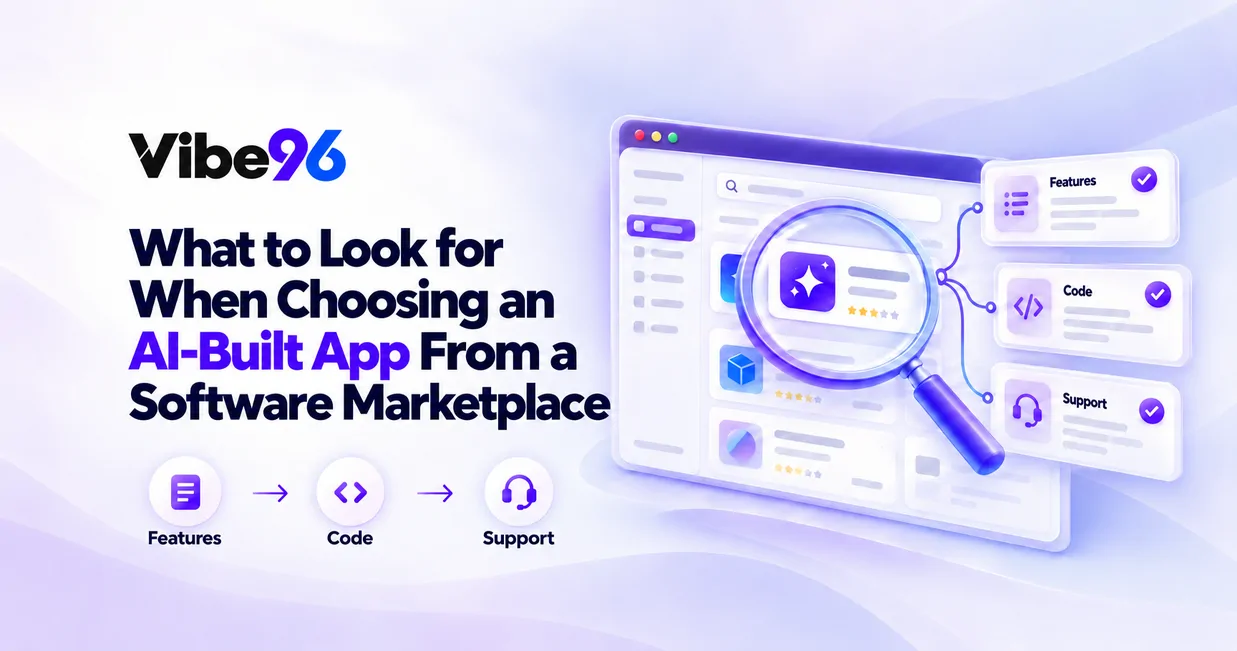
Compare audit scores, not just star ratings
A star rating reflects buyer satisfaction, which is useful but subjective. A code quality audit for AI generated code reflects something more concrete: whether secrets are exposed, whether dependencies carry known vulnerabilities, whether access control was tested. Weigh both, but treat the audit result as the harder, more reliable signal when the two disagree.
Check whether the stack matches your team
An otherwise excellent listing is a poor choice if nobody on your team, and no AI coding tool you have access to, can work in its stack. Confirm the language, framework and database before narrowing your options further, since this single factor eliminates more listings in practice than any feature comparison does.
Look for a working demo, not just screenshots
Screenshots can be flattering in ways a live demo cannot be. Click through the actual demo, test a few edge cases if the listing allows it, and confirm the interface matches what is described rather than an earlier or aspirational version of the product.
A shortlist to run through before deciding
• Does the core workflow match what we actually need, not just the category label
• What did the audit specifically check, and were there any open findings
• Can our team or AI coding tool work comfortably in this stack
• Does the live demo match the listing description
• What licence and support terms come with the purchase
Running through this list takes a few minutes per listing, which is a small cost compared to the time lost if a poorly chosen purchase needs to be replaced a month later.
Weighing price against total cost
The purchase price is rarely the full cost of owning a piece of software. Factor in what hosting will cost once it is live, whether any customization work is likely, and whether the stack is one your team can maintain for free or will require paid help. A cheaper listing on an unfamiliar stack can end up costing more once these are accounted for, once hosting, learning time and the occasional developer invoice are added up honestly.
Browsing with these criteria in mind
Applying this kind of filter manually across dozens of listings is slow. A marketplace organized by category, with audit scores and stack details shown on every listing, makes the comparison far faster than requesting the same information from individual sellers one at a time.
Vibe96's Vibe Coded AI App Marketplace lists this information on every project page, so narrowing a category down to a shortlist takes minutes rather than a string of back-and-forth messages.
A final gut check before committing
After running through the practical criteria, it is worth asking one more honest question: would you still feel comfortable with this purchase if the seller never answered another message. Most purchases hold up fine against that test. The ones that do not are usually relying on a promise of future support rather than what the listing actually demonstrates today, which is a risk worth noticing before paying rather than after.
Trusting the process more than any single listing
No individual listing is ever going to be a perfect fit on every dimension. The goal of a structured selection process is not to find a flawless option, it is to make an informed trade-off deliberately, rather than discovering the trade-off only after the purchase is already made and difficult to undo.
What this looks like across different categories
The specific weight given to each criterion shifts by category. For a CRM or an internal tool, stack fit and data handling tend to matter most, since these run for years and touch sensitive information. For a smaller utility or a mobile app, speed of launch and price often take priority, since the cost of switching later is lower. Adjusting the weighting to the category, rather than applying one fixed formula everywhere, produces better decisions than treating every purchase the same way.
A useful habit is to decide this weighting before browsing listings, not while looking at one you already like. Deciding what matters most in advance keeps a particularly polished demo from quietly overriding a criterion you would otherwise have treated as a dealbreaker.
Choosing the right AI-built app comes down to fit, verified quality and a stack you can actually work with, in that order, more than it comes down to the longest feature list or the lowest price. A short, consistent process applied to every listing you consider turns what feels like guesswork into a comparison you can actually defend afterward.