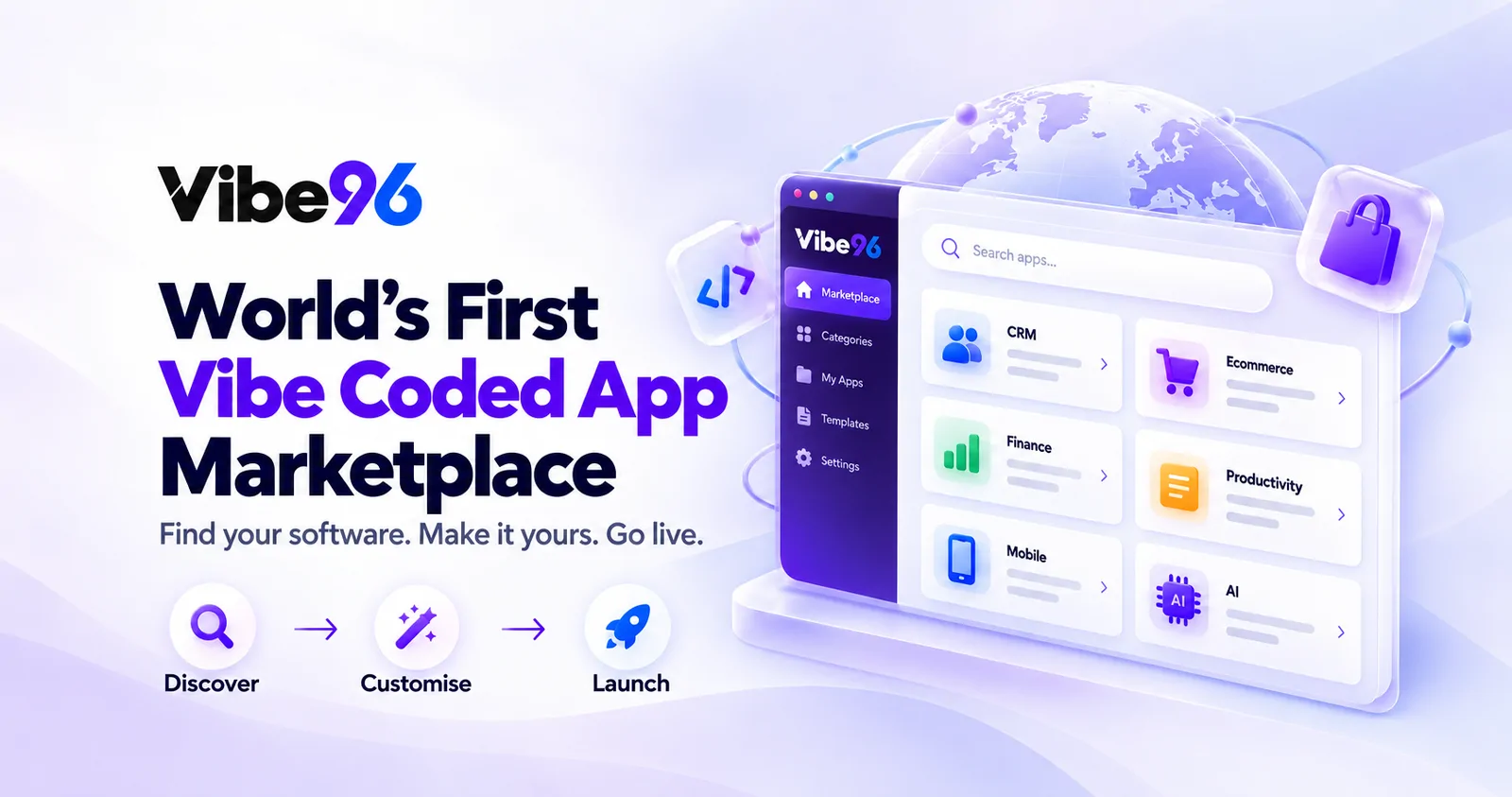
Something changed in how software gets built once AI coding tools became good enough to turn a plain-language description into a working application. Within a couple of years, thousands of real, usable apps existed that no one had written line by line, built instead through a conversation with a tool like Claude Code, Cursor, Replit or Lovable. What never quite caught up was a place to actually buy and sell them safely. Vibe96 describes itself as the world's first vibe coded app marketplace built specifically to close that gap, and the shape of the platform, an audit before anything is listed, categories organized the way businesses actually search, hosting to get a purchase live, and a workspace to keep improving it afterward, reflects a product built around a problem that is genuinely new.
This is not a claim about who built the first AI coding tool. It is a claim about building the first marketplace structured specifically around buying, selling, launching and improving software that an AI coding tool produced, with the trust mechanisms that kind of trade actually needs. What follows is a look at how that structure works, piece by piece.
Why vibe coded software needed its own marketplace
Before Vibe96, someone who built a working CRM or booking app with an AI coding tool had a narrow set of options if they wanted to sell it: a general code marketplace built for templates and plugins, a freelance platform built for commissioned work, or an informal sale through a forum post or a direct message. None of these were built around the specific risk profile of AI-generated code, which can run perfectly in a demo while still containing a hardcoded credential, an untested authorization check, or a dependency with a known vulnerability that nobody thought to look for.
A buyer facing that landscape had almost no way to tell a carefully reviewed project apart from one that had never been looked at past the point where it happened to work. That gap, not a lack of AI-built software but a lack of a trustworthy way to trade it, is the specific problem Vibe96 was built to solve.
It is worth being precise about what was missing, because it was not demand. Plenty of working, genuinely useful software was already being produced by AI coding tools every day. What was missing was the infrastructure around that software: a consistent way to verify it, a place organized for buyers to actually find it, and a path from purchase to something running in production, none of which a general-purpose code marketplace or a chat-based AI tool was built to provide on its own.
The audit that makes buying AI-built software safe
Every listing on Vibe96 goes through a review before it becomes public. A project submitted for sale needs to clear a minimum overall score of 75 out of 100 with no failing check, covering things like exposed secrets in the source code, dependency vulnerabilities, access control gaps, and whether the application actually builds and runs from its own setup documentation on a clean machine. This is not a cosmetic check performed once and forgotten. It is the mechanism that lets a buyer trust a stranger's codebase without personally auditing it line by line first.
For a seller, the same audit works in their favor. A listing that clears the bar is worth more and attracts fewer disputes than one nobody has verified, because the audit result becomes part of what is actually being sold, not a hidden risk a buyer has to discover on their own after paying. The same structure that protects a buyer's purchase also protects a seller's reputation, which is part of why both sides of the marketplace tend to reinforce each other rather than pull in opposite directions.
Categories built around how businesses actually search
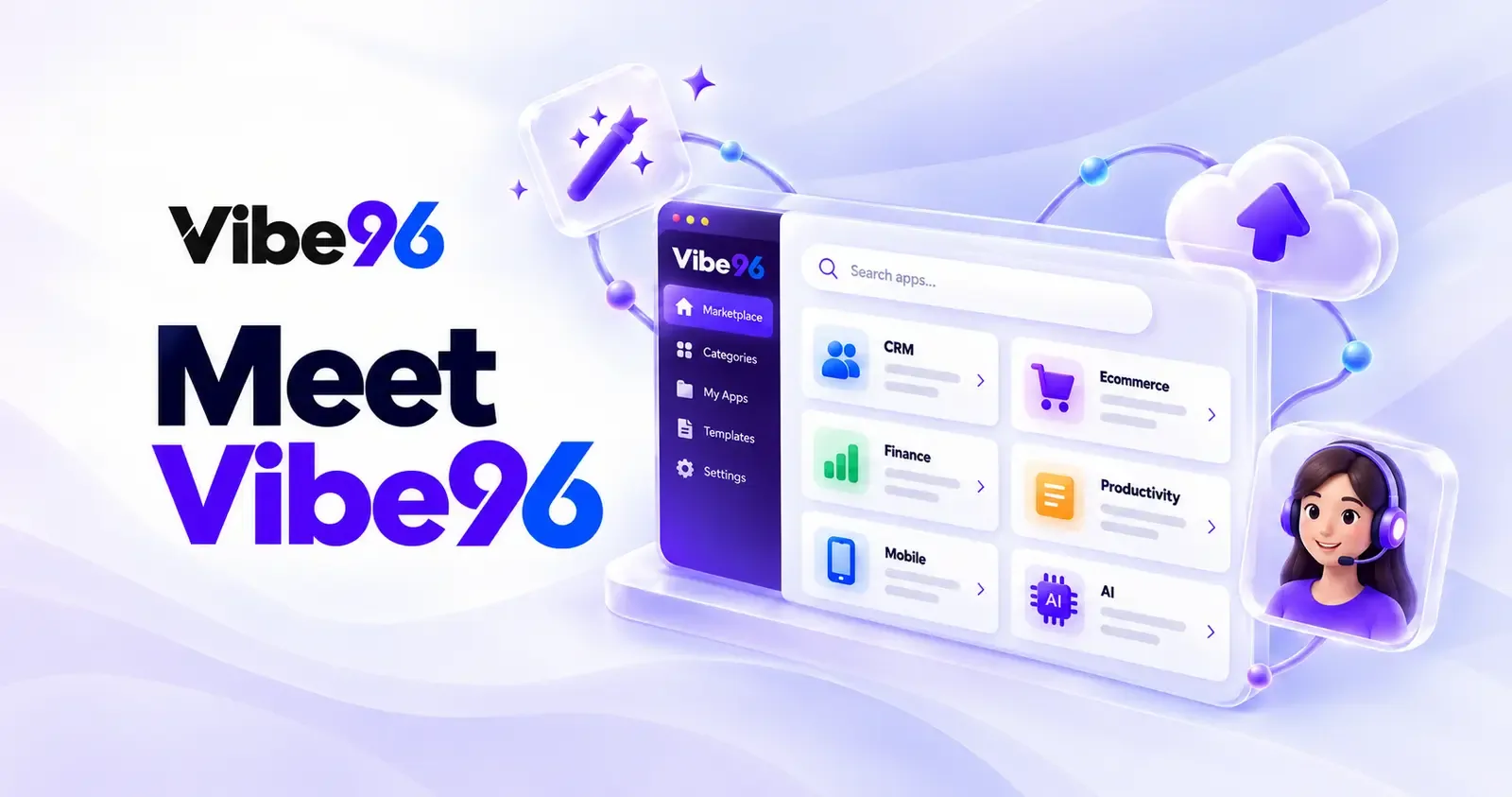
Rather than one undifferentiated catalog, listings sit inside categories that match how a business actually thinks about its own needs: Business & Operations, AI & Automation, E-commerce & Retail, CRM, Real Estate & Property, Education, HR & People, Sales & Marketing, Websites & CMS, Developer Tools & Infrastructure, Finance & Accounting, Logistics & Mobility, Media & Content, and Mobile Applications. Searching inside a category surfaces options a buyer might not have thought to search for by name, and makes it easier to compare two listings solving the same kind of problem at a different depth rather than two unrelated products that happen to share a label.
Get it Live: the piece most marketplaces skip
Buying source code online solves what you are going to run. It does not solve where, or how it gets there safely, which is exactly where most marketplace purchases quietly stall. Vibe96's Get it Live service closes that gap directly, with Linux and Windows VPS plans sized by expected daily traffic, GPU hosting for projects running AI inference, and app store publishing for mobile projects, including resubmission support if a store review comes back with changes needed.
Hosting is prepaid for 3, 6 or 12 months, with daily snapshots and renewal reminders sent well before a term ends, and a backup kept for three months after a server is terminated in case the decision to stop gets reversed. The point is not just handing a buyer a running server. It is treating deployment as its own deliberate step, with the same level of care as the purchase itself, rather than an afterthought left entirely to the buyer to figure out alone. A buyer who brings their own code, rather than something purchased on the marketplace, can use the same service, as long as it meets the same basic deployment requirements.
Vibe Studio: improving software you already own
Most AI app builders are built around starting fresh: describe an app, and the platform generates and hosts it inside its own environment. Vibe Studio, Vibe96's AI-assisted workspace, is built for the opposite moment, improving an application you already own and run on your own server, whether it came from the marketplace or was built independently.
Inside Vibe Studio, Nova studies your actual page and prepares a design preview grounded in your existing style before any development begins, with a cost estimate shown for each task before you approve it. Claude handles the code development behind an approved change, with Vibe Auto choosing the right Claude model for each specific task, and ChatGPT generates new images when a task calls for visuals. Version history is kept for every change, Git and GitHub sync lets a developer keep using their own tools alongside the workspace, and the current live version keeps running until a new deployment passes, with automatic rollback if something does not respond correctly. Against build-from-scratch platforms like Replit and Base44, this combination of your own server, full code ownership, a cost estimate before every task, and a design review before any code is written is the clearest point of difference.
Four assistants, one connected journey
Rather than routing every task through one general-purpose assistant, Vibe96 spreads the experience across four named assistants, each matched to a different part of the journey. Vee is the buyer guide, helping a visitor find the right software when they are not yet sure exactly what they are looking for. Nova is the Vibe Studio developer, helping someone make changes to a project they already own. Axel is the tech helper, walking a buyer through hosting choices and launch setup once a project is ready to go live. Remy is the builder partner, helping a seller prepare a listing and get it through the audit before it ever reaches a buyer.
The value of splitting the work this way shows up in the handoffs. A conversation with Vee about finding software never has to double as a conversation about hosting, and the help Remy gives a seller preparing a listing is not diluted by also answering a buyer's questions at the same time.
When AI isn't enough: developer help on call
Some tasks are not safe to leave entirely to an AI coding tool, regardless of how capable it is. Payment gateway integration, ERP and accounting connections, single sign-on, data migration from a legacy system, and anything touching access control are the recurring examples, since the cost of a mistake in any of them is high enough to justify bringing in an experienced developer rather than pushing through with another round of prompting.
Vibe96 addresses this directly: asking for a developer is free, and the platform introduces one or two vetted developers, each a seller whose own listing scored 85 or above on the audit, within two business days, with a fixed-price quote attached to each. Payment goes through Vibe96 rather than directly to the developer, held until the delivered work is accepted, and work delivered this way passes the same audit as every marketplace listing before it lands in the buyer's repository.
Built for sellers, not just buyers
A marketplace only works if both sides of it are genuinely served, and Vibe96's seller side mirrors the care given to buyers. There is no listing fee and no monthly fee to register and list a project, pricing is set by the seller, and the same project can be sold to more than one buyer under a single-site licence, since each sale grants a licence rather than transferring sole ownership. Payouts happen monthly, on the 5th, for the previous month's sales, with a minimum payout of $200 and smaller balances rolling forward.
Sellers are expected to publish updates for 12 months after each sale and respond to support tickets within two business days for the first 30 days, which protects buyers without locking a seller into open-ended obligations. A project can be unlisted at any time, and existing buyers keep their access regardless.
Who built it
Vibe96 is led by CEO John Bush, focused on commercial strategy and partnerships, and CTOO Rajib Roy, who leads engineering and technical delivery, with the platform built in Dubai and serving builders and businesses globally. The combination of a commercial lead and a technical lead at the top mirrors the platform itself: a product that has to work equally well as a place to trade software and as a place to actually build it.
What “world's first” actually means here
AI coding tools are not new, and Vibe96 does not claim to have invented vibe coding itself. The claim is narrower and more specific: a marketplace built from the ground up around the full life of a vibe-coded project, an audit before listing, categories organized by real business need, hosting to get a purchase live, a workspace to keep improving what you own, and a path to a human expert when a task needs one, rather than a general code marketplace with AI-built listings mixed in among everything else.
That combination, audit plus categories plus hosting plus an improvement workspace plus developer access, inside one connected platform, is the specific thing being described as a first. Whether a reader accepts the superlative or not, the underlying structure is real and documented, which is ultimately the part worth evaluating on its own merits.
Where it's headed
Vibe Studio is currently in beta, included with a Vibe96 project deployment and running on pay-as-you-go credit, with free credit included for new accounts. Vibe96 has named plans to add further AI specialists to the Studio workflow, including models from Kimi and DeepSeek, extending the same coordinated, multi-model approach to new kinds of tasks rather than asking any single assistant to cover more ground than it is actually suited for.
Vibe96's Vibe Coded AI Marketplace is the place all of this comes together: browse by category, check the audit before you buy, launch with Get it Live, and keep improving what you own with Vibe Studio once it is yours.
Vibe coding solved the problem of building software quickly. It left open the much harder question of how to trade that software safely once it exists, how to know a listing is sound before paying for it, how to get a purchase live without becoming a systems administrator overnight, and how to keep improving it afterward without starting over. Vibe96 was built around answering all four of those questions inside one platform, which is the real substance behind calling it the world's first vibe coded app marketplace.