An AI coding tool can take a vibe-coded app from idea to a working demo faster than almost any traditional process.
What it does not reliably do is take that same app from demo to something that can safely handle real users, real payments and real data. That gap is why, sooner or later, most teams end up needing to hire a developer to fix my app rather than pushing the original AI-generated version straight into production and hoping it holds.
This is not a criticism of vibe coding as an approach. It is simply a reflection of what these tools are optimized for, which is getting something working quickly, not anticipating every way a determined user, or a careless one, might interact with the system once it is live. The teams that get the most value out of vibe coding tend to be the ones who treat this as a known, expected step rather than a surprise that derails a launch at the last minute.
What “production ready” actually means
A demo only has to work for the exact path someone clicks through during a pitch. Production has to work for every path a real user might take, including the ones nobody thought to test: a payment that fails halfway through, a form submitted twice, a user who should not have access to a particular record but tries anyway regardless. AI coding tools are good at the happy path, because that is usually what the prompt describes. They are far less reliable at anticipating the messy, adversarial reality of actual usage, which only shows up once real traffic arrives.
Where vibe-coded apps commonly break
A few patterns show up repeatedly once a vibe-coded app meets real traffic:
• Authorization checks that exist in the code but were never actually tested against a real attacker's approach
• Database queries that are not properly scoped, letting one user see or edit another user's data
• Error handling that works in a demo but fails silently, or loudly, under unusual input
• Third-party integrations, such as payment gateways, that were stubbed out and never fully connected
• Performance that was never tested beyond a handful of test records in a development database
Any one of these on its own might be a minor fix. Together, they are usually a sign that the application was built to demonstrate an idea, not to carry the weight of a live business, and should be treated accordingly before launch.
The role of a production readiness review
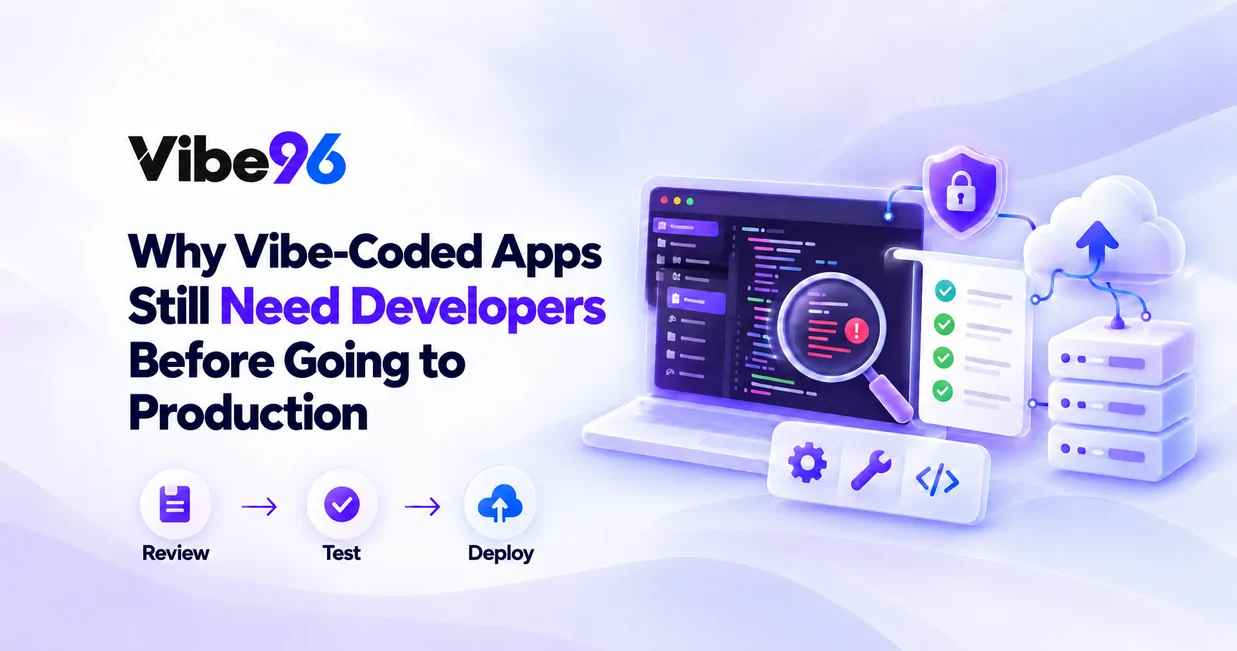
A production readiness review is a structured check of everything above before launch, rather than hoping it holds up afterward. It typically covers authentication and authorization, data handling, error states, and whether the application can actually be deployed, backed up and monitored the way a live system needs to be. This is usually the point where gaps that were invisible in a demo become obvious, since a reviewer is actively looking for them rather than clicking through the intended path only.
What an AI code security review actually checks
Security review is a narrower, more specific pass focused on exposure. It looks for hardcoded secrets left in the source, dependencies with known vulnerabilities, and access control gaps that could let one account reach another account's data. This matters as much for a project you built yourself as for one you bought, since an AI coding tool has no way of knowing which parts of a generated codebase carry real risk once deployed into a live environment with real accounts attached to it.
When to hire a developer instead of pushing through alone
Not every gap needs a developer. Minor UI fixes or copy changes are usually fine to handle with the same AI coding tool that built the project. A payment gateway integration, a data migration from a legacy system, single sign-on, or anything touching access control is different. These are the areas where experience catches problems an AI tool is unlikely to flag on its own, and where the cost of getting it wrong, a data leak or a broken checkout, is far higher than the cost of a short, scoped engagement to get it right the first time.
Building a basic readiness checklist into every launch
Regardless of who built the app or which tool was used, a short checklist before launch catches most of the common gaps:
• Every authorization check has been tested with an account that should not have access
• No credentials or API keys are hardcoded anywhere in the source
• Dependencies have been checked against known vulnerabilities
• Error states have been tested, not just the expected, successful path
• A backup and monitoring plan exists before real users arrive
Finding reviewed projects and expert help in one place
Software due diligence before purchase matters just as much as it does before launch. Buying from a marketplace that already runs an audit on every listing removes one layer of risk, and having a path to bring in a vetted developer for the parts that still need one removes another, without forcing you to find and screen a freelancer from scratch under deadline pressure.
Vibe96's Vibe Coded AI App Marketplace pairs audited listings with access to developers who can handle exactly this kind of pre-launch work, so the step from demo to production does not fall entirely on a team that may not have built the original app in the first place.
Vibe coding is a genuinely fast way to get to a working first version. It is not, on its own, a substitute for the review and hardening that production software needs before it meets real users. Treating the gap between demo and launch as a real step, with real review, rather than an afterthought, is what separates apps that hold up under real traffic from ones that break on day one.